Today marks 80 years since the first use of a nuclear weapon against people during wartime.
By happenstance, I just finished reading this small book, Hiroshima by John Hersey. Written a year after the explosion, it follows the story of six survivors of the blast, recounting their experiences on the day and their lives throughout the next year, as well as a bonus chapter rounding out their stories 40 years later.
It is a poignant book; telling the story not of the moral dilemma of whether the bomb should have been dropped or the effect it had on history’s greatest calamity, but instead the human cost of war, and total war in particular.
I highly recommend this book.
Especially in a time when many dismay at the current state of the world, or our direction in history, or even the possible doom AI may bring; it is important to remember the truly formidable challenges we as a species have faced in the past, and how we overcame them to make a world that is undoubtedly better than the one that led to WWII and the dawn of the atomic age.
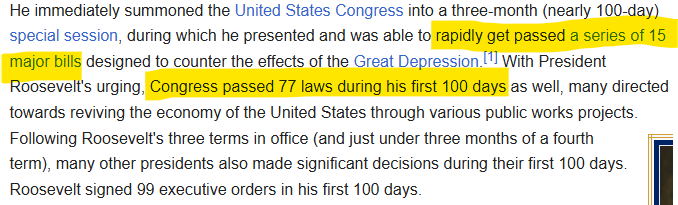
The reason people comment on a president’s first 100 days is pretty much all down to FDR, and the beginning of his first term in 1933. So while people opine on Trump’s first 100 days of his second term, I think its important to look at what an intelligent and capable leader is able to achieve, versus the unthinking and incompetence we are seeing these days. FDR achieved so much because he was a leader with a vision and a plan, not a egotist with a victimhood complex, and a list of grievances. As a quick example, look at these points from his First 100 Days wiki entry:
When you are a good leader you don’t have to bully and cheat to try and get things your way. I don’t want to risk turning my first post in ages into a rant about Trump stuff, but thought that this was worth noting as I always hear about someone’s ‘first 100 days’, but never really knew what could be accomplished in such time. FDR built the seeds of what would make America dominate in the 20th century, and now Trump is sowing the seeds of the destruction of America’s reputation and soft power.
Luckily he wont have 4,422 more like FDR did, and is stuck with only 1,361.
So far this year, I have only finished six books. Not too bad for around 8 weeks, but still less than I had hoped. However, at least they have been a diverse set of books, with one that really altered my view of the world.
This book is a contender for best cover of the year; I just love it.
Indeed, changing my view is an apt term, as the book in question, “An Immense World” by Ed Yong, is all about animal senses, and how the creatures we share this world with have vastly different experiences of what it means to view the world. This book really helped me to appreciate the fact that how we see the world is not the only way. I mean, I always knew that animals had different senses, but never fully appreciated how fundamentally foreign this made their view of the world. Plus, I learned the term “umwelt,” and it’s always cool to find a new German word for a concept that you never knew existed.
Then I added in a couple of relaxing fiction books to the fold: the first two entries in Richard Osman’s Thursday Murder Club series. Well, as relaxing as murder mysteries can be. Actually, this was another interesting foray into different points-of-view, as I quite liked reading about protagonists who were nearing the ends of their lives, and how this change in perspective affected the motivations of characters and flow of storylines.
That’s an Americana in case you were wondering.
“Spare” by Prince Harry was a revealing look into modern royalty. I had never bothered much with the scandal and tabloid stories regarding the royal family, and mostly kept my royal watching to the big events (weddings, funerals, and jubilees). But being as Harry is my age, I was keen to hear his side of things. And basically, it’s what I expected. The institution of the British Royal family is clearly one not well-suited to providing a sound mental health support to a growing man, especially one who had his mother taken from him in such a jarring way.
“Courage is Calling” by Ryan Holiday is exactly what you would expect it to be if you have read any of his other works centred around the stoic way of life. I like picking up these books as he dutifully churns them out, to help guide my thinking in approaching everyday life. So many philosophies can seem academic or separated from daily life, but stoicism always seemed the most practical and applicable.
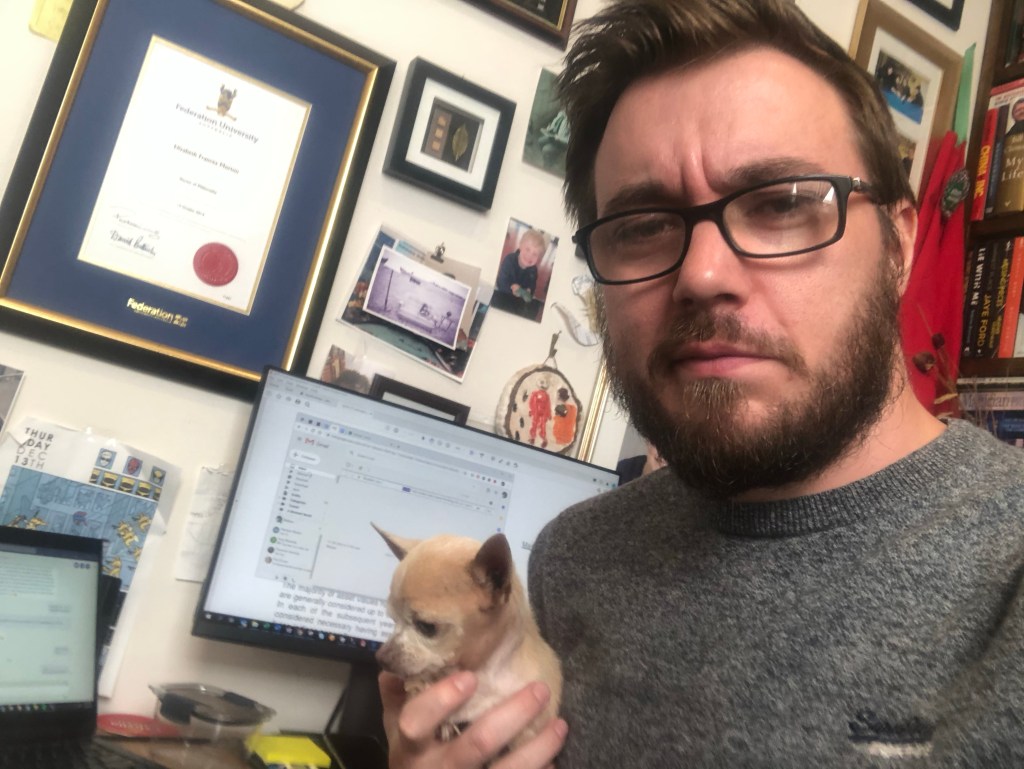
A bonus appearance by Saskatoon, who wasn’t quite enthusiastic about me reading instead of paying attention to her.
And lastly, “First Steps” by Jeremy DeSilva, a fascinating book detailing the unique nature of human bipedalism, how it evolved, and how much of the way our species came to develop and dominate the globe was impacted by the strange journey we took moving around on two feet. What’s more, this book was given to me by my son for Christmas, and I was thoroughly impressed at how well-suited it was to my tastes, and yet how it had up until then flown under my radar (which is usually so adept at finding books I want to buy).
Anyhow, that’s my recap on 2023’s books so far; looking forward to this month’s selections.
How could so much love, and so many big memories, come from such a small little thing?
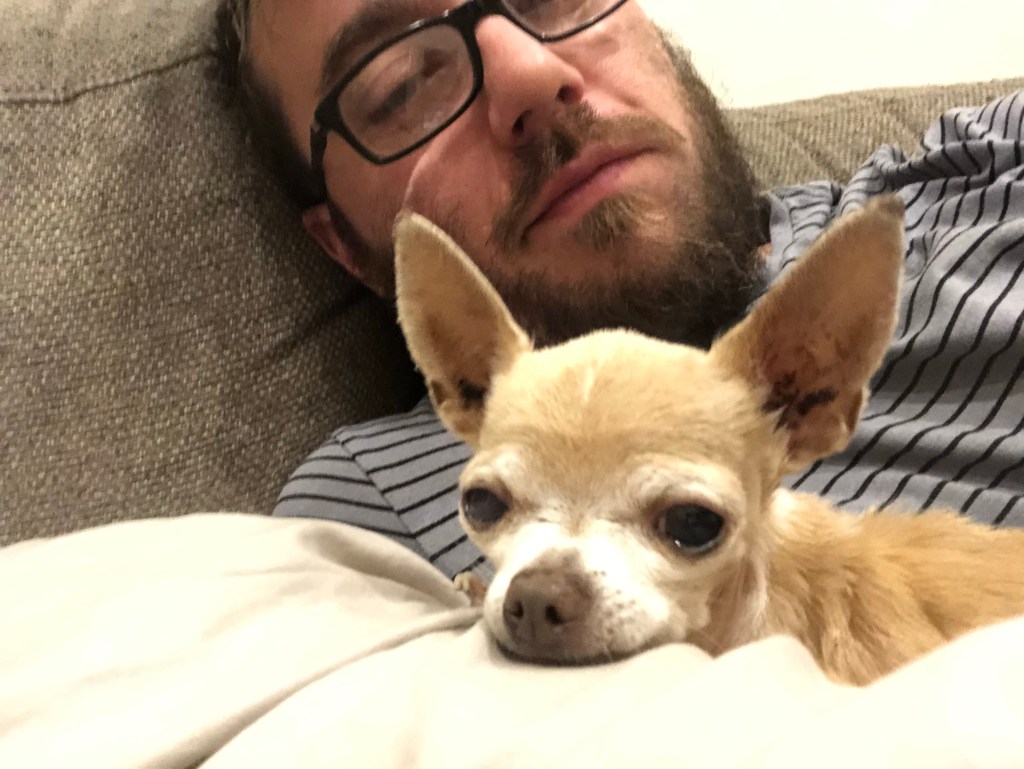
I have never met a dog more loving than Pi. If you met Pi, you will either understand this, or you will think it strange. Sure if you came around and he didn’t know you, or you moved your feet around a bit too much, you would cop an earful off that miniscule bark. But once you sat down and got to know him, he was always up for a pat, and a chill on your lap.
But for us, for his little family, we felt that love every day.
His little eyes looked up at us with such affection. He would climb up our bodies like a mountain goat and literally grab us in a tiny bear hug. What more would you expect from a pet who grew up with us as we were building our family, raising a son, and making a life together. What else but a dog that loves cuddles could have been the result of him literally living in my hoodie pocket as a puppy, or spending the mornings at our breakfast table zipped up in my wifes jacket.
Years ago I gave my wife a task. I said “The next dog we get I want you to find the weirdest little thing you can”, and boy did she deliver!
He was the tiniest dog I have ever seen, the strangest little fellow, so far removed from what many consider a real dog that to me it made sense to treat him like a sentient little dude. He tried so hard to speak; little barks turning into growls and croaks. A tiny language. What he couldn’t say you could see in his emotive little brow, so full of concern, or contentment.
Every winter when things would get colder and we would sacrifice one of our sons socks to make him his own winter coat.
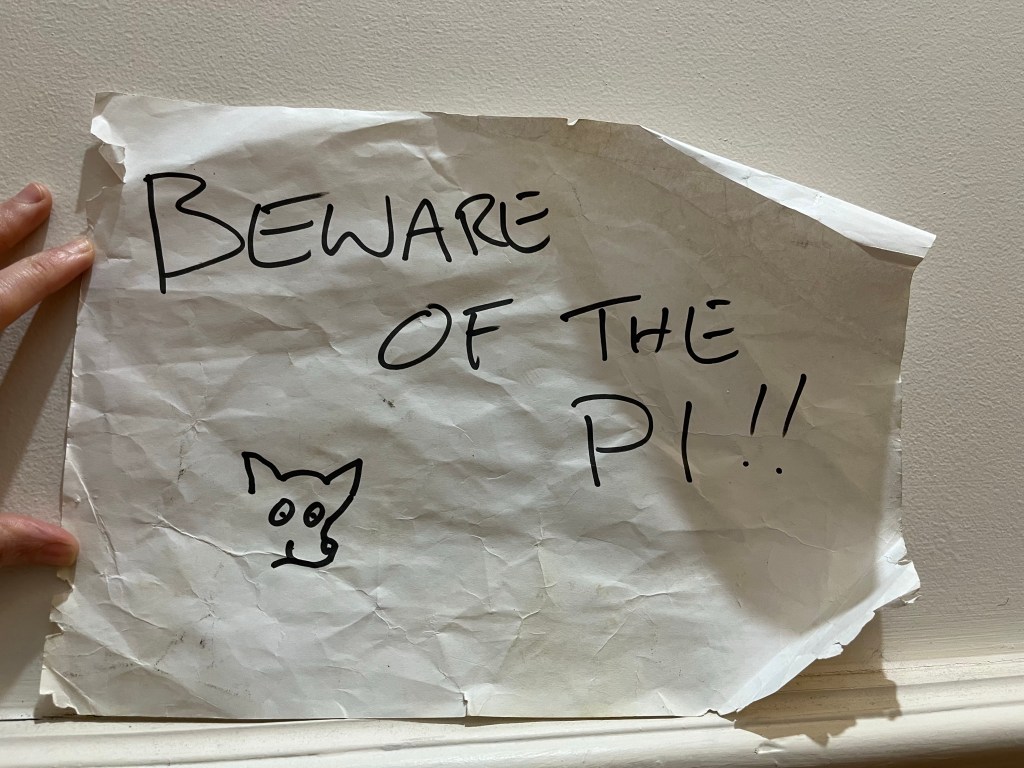
He would get so cosy under his blanket on the couch that we had to put a warning sign on it to make sure no one sat on him!
Pi was my little fella. Mr Pi; who would be content to sit in my lap all day, and not raise too much of a fuss when I would have to hold him in one hand and carry out some errands. Carrying him around people would always coo over him, and ask how old our puppy was, never expecting that he was actually a wise little man almost as old as our son.
I know everyone says that their pets are members of the family, but Pi really was. We treat our pets like people, and thats what makes it so hard to see him go.
Yes I am getting emotional, and yeah maybe I am making this out to be a bigger deal than some may think it is, but screw it all he was very special to me and I am not afraid to blub about it and let everyone know.
I will miss him forever. But I know that eventually the tears will pass, and I will be left with so many good memories, so many positive experiences, that Pi won’t ever leave me. And I am grateful for that.
Whenever I hear officials or commercial groups saying that we need to learn to live with COVID, what I think they really mean is we need to go back to how things used to be, because this is harming my interests. To my mind I think we need to learn to live with COVID, as in we need to take the good things we learnt during the pandemic, and continue to develop them. Learning to live with COVID means that organisations need to learn to live with the fact that I can work from home if I want to.
Learning to live with COVID can mean we need to learn to live with the fact that we are a connected society, and we need to support everyone through difficult times (both in their lives and in society in general), because what we do as individuals is connected to others’ welfare.
Ok, so here is my prediction. Trump will drag on his ‘contention’ of the 2020 election, doing everything he can to fire up his audience, and not admit defeat. He will build up the story that he was robbed of the election, and not to trust the ‘Media’. But this isn’t some kind of slow coup, or attempt to stay in the White House. Trump doesn’t actually want to govern, he will leave in January.
You can sense this in Trump and his team’s current actions. His various court cases are being struck down constantly as they don’t have strong legal grounding or sufficient evidence; they aren’t serious cases. Meanwhile numerous public ‘hearings’ are organised, spreading conjecture and hearsay in order to focus on the one court he cares about; the Court of Public Opinion.
Next comes Trump’s media company.
Having built an audience, and got them to distrust the media, he will launch his own platform (e.g. Trump Media), and call it the source of truth (and importantly—unlike Twitter—something he can make money directly from). Everything else is fake except Trump’s version of the truth (i.e. lies). Seems the perfect way to make money and keep his sense of importance; and we all know that that is literally all there is to Trump. This is a man who has claimed to know more about the military than generals, more about science than scientists….blah blah, you know all this by now.
Trump is the perfect conduit for others’ ideas, there is no depth to him, he is all superficial surface, and other entities are willing to put up with him to get their things through. But with Trump gone, the Republican party will have to move on, at least in theory. Trump won’t wait around and think of the best political strategy for the future; Trump doesn’t strategise, he doesn’t build coalitions. He will just do whatever he can to be the centre of attention.
So with no actual philosophy, or ideals to guide him, and no party platform for him to pretend to follow, he will bluster and scream, and make sensational claims to get the feedback he needs to feel good. He is a troll, and this is what trolls do.
He will (hopefully) be banned from Twitter if he continues his terrible ways, as his protection as a head of state will no longer be able to save him. Again, the perfect opportunity for him to claim persecution and drive people to his new platform. A platform he owns, and with which he can make money.
Will he run in 2024? Who knows. I am sure he would like to because the United States spends so much money on elections, and holding rallies/events at Trump properties is a great way to fill the coffers. But I hope the world gets to the point where there is no interest in Trump running. I hope the Republican party has some decent alternatives for those voters who don’t necessarily like Trump the person, but are willing to put up with him simply because of the Republican policies that come in his wake. The fact that Republican candidates did well in the election, but Trump didn’t, should give them reason to reflect on where to place their bets in 2022 and 2024.
This is my prediction for the rest of the Trump story. Either that or he will move to an island or some remote compound, and declare himself the true President of the United States in exile.
In September I managend to read five books, and restrained myself to only buy an additional five books. So it was one of those rare moments when I broke even!
Completed Books
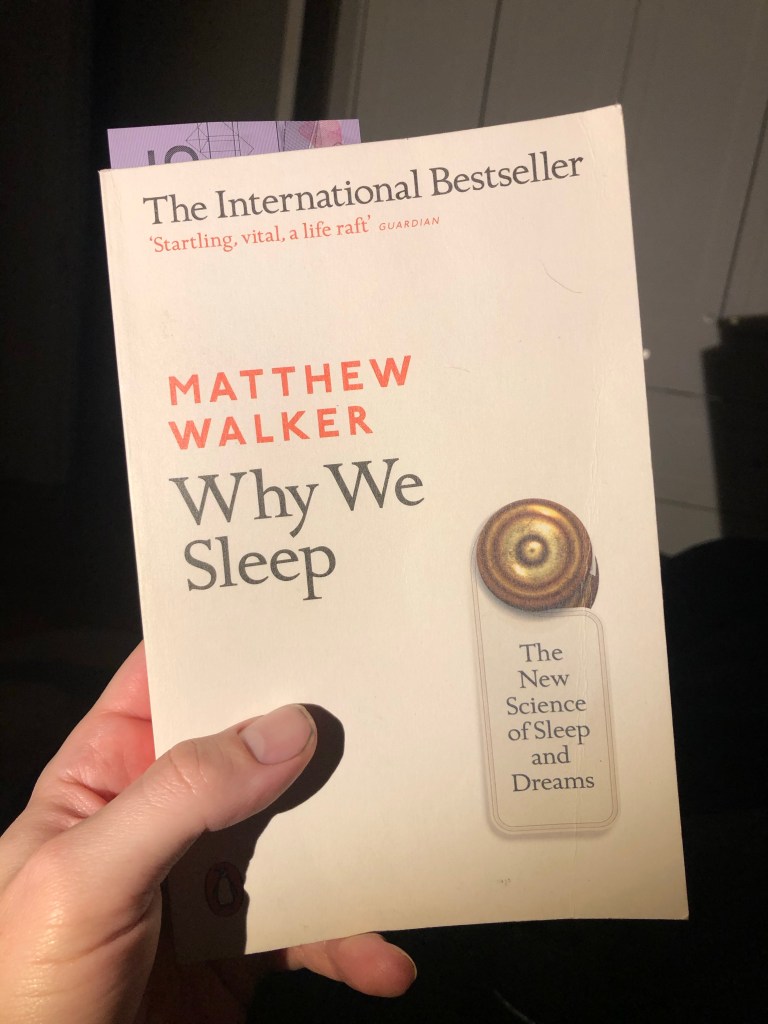
Why We Sleep by Matthew Walker
Every night I lay in bed with this book past midnight agreeing with all the points it was making about how I should have been sleeping instead of staying awake reading…
If you read my previous post you will see that this book really had an effect on me, I have know that sleeping is important for years, and that I dont get enough. But reading this book has spurred me into action for the first time in order to try and address the problem.
I had heard a bunch about this book since it was released a few years back, and even though there was some concern about some of the science in it, most sources agree that the overall thrust of the book is worth listening to.
If you have ever been interested in sleep, or want that extra push to start tackling your own sleep problems, I highly recommend the read.
Falcon Helen by MacDonald
My late night reading buddy.
Everyone was raving about Helen Macdonald’s book ‘H is For Hawk’ a few years ago. I read it and was impressed, so when I saw this on sale I figured I would give it a go. Whereas H is For Hawk was a blend of a person dealing with grief, mixed with a history of hawking, this book deals simply with the subject of falcons. It gives an overview of the animals themselves, but then also analyses how they fit into human myths, society, and the world we have created. A quick read, but a satisfying one.
Plus it reminded me about this livened, which I frankly just love:
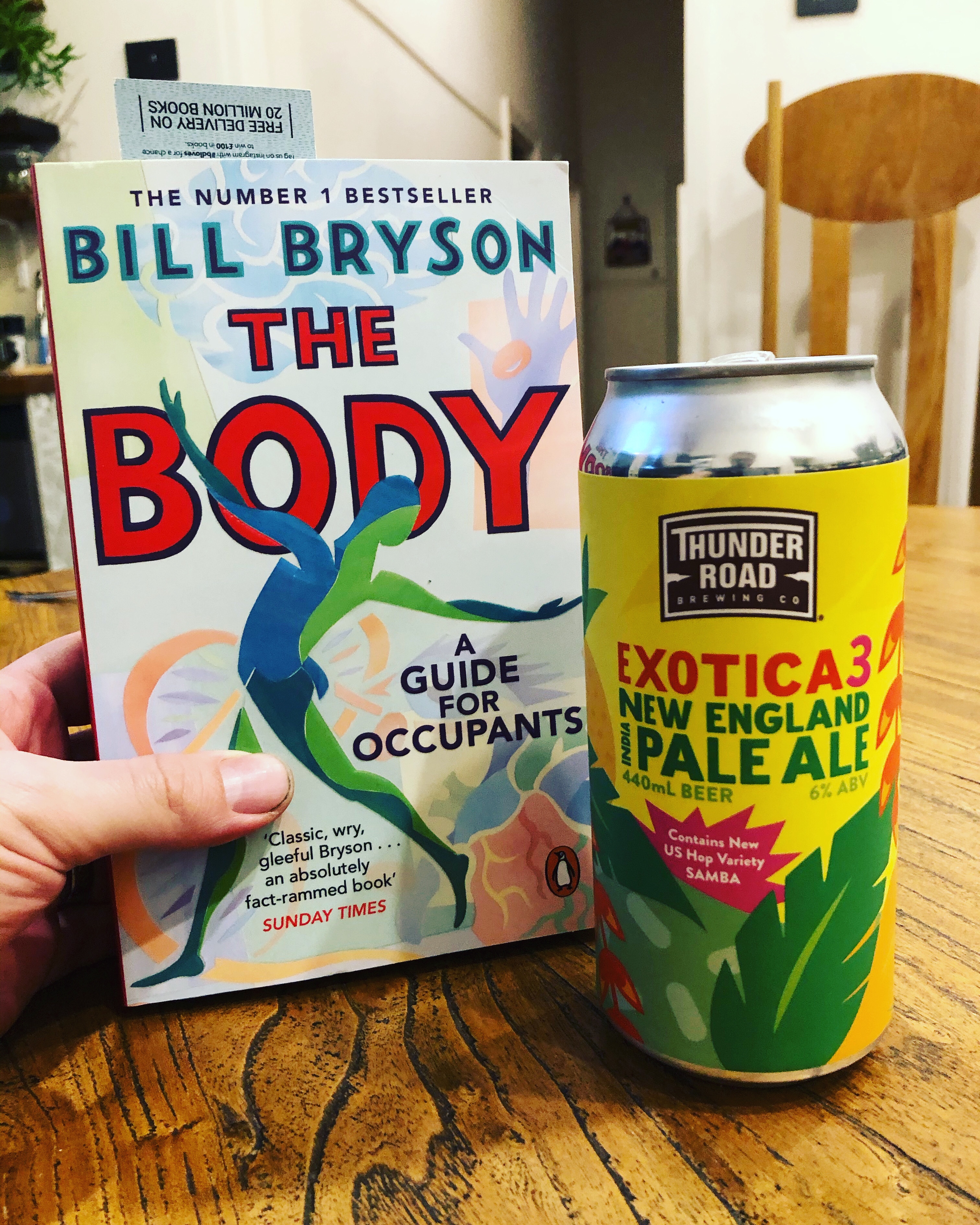
I had only ever read a short Bill Bryson book about Shakespeare a year ago, but have always heard people rave about his more in-depth books. Amazon and Google’s algorithms were hammering me with ads for this book when it came out, but I managed to resist for ages because the Hardcover was frankly just too much for my wallet ($45!).
I was pretty proud of myself for not giving in, and subsequently went on my merry way.
Then the paperback was released for $16 from Big W….
I loved this book. It was chock full of facts and interesting stories, each chapter delving into a different part of the body and giving you a greater appreciation for the vessel that carries you through this life of ours. I would highly recommend this for anyone who is even remotely curious about the world. It isn’t overly technical, and is amazingly easy to read (I chewed through the 521 pages in one week).
The Prince by Niccolò Machiavelli
More books, and more beer. You can’t quite tell, but it is The Prince I am reading.
This is one of those books that you always want to read, but never really get around to it. The word Machiavellian is well with popular realm, but where does it all come from. I wanted to know.
I bought this book for my son at the start of the year after a character in his book mentioned it. Whenever my son shows any interest in a book that I am interested in, I instantly use this as the best excuse ever to buy a new book.
Its for my son dammnit; I have to buy it!
He hasn’t read it yet (his pile of books to read is almost as big as mine), but I was amused when I asked to borrow it from him and he said something along the lines of, “Ah, wanting to learn how to manipulate people hey?”.
Brilliant!
As for the book itself, it was quite interesting. Surprisingly modern in the way it is written (though this may be the work of the translator, I dont know), and yet also gives you a nice understanding of the world it was written in. It reminds me of when I read Sun Tzu’s Art of War; you get a good understanding of some of the unchanging laws of strategy that transcend time and culture, but then you also get a bunch of irrelevant information, like how many goats to ransom people for, or what certain regions of Italy are talented in.
One of my mates also brought to my attention the interesting question of whether this book is a how to guide for a Prince, as it is presented, or whether it is written for the population, so they can understand how their leaders control them. This is part can explain why the language is so approachable; it was written in the common Italian of the day, not the more traditional Latin.
An interesting read, and definitely worth taking a look at, if only so you can add it to your list of classic texts.
Fuzzy Nation by John Scalzi
I love a good Scalzi. My only criticism of them is that I read through them so damn quick! Two days is not long enough with these characters, in these worlds. I want more!
This book is a strange blend of court procedural, and alien first contact. A very approachable read, keeps you entertained, with enough to make you think, like any good science fiction should.
Started/In Progress:
Meditations by Marcus Aurelius
Talking to My Country by Stan Grant
Purchased:
The Rise and Fall of D.O.D.O. by Neal Stephenson and Nicole Galland
The Wall of Storms by Ken Liu
The Lives of Stoics by Ryan Holiday
Planetes by Makoto Yukimura
The Bird Way by Jennifer Ackerman
On the Horizon:
The Ministry of the Future by Kim Stanley Robinson
The Two Lost Mountains by Matthew Reilly
Holy crap; this month my two favourite authors release new books, on the same god damn day!
I can’t imagine a better problem to have these days, than the issue of deciding which new book to read; one by Australia’s best action author, or one by the best creator of hard science fiction currently plying the trade….
A lovely dilemma to have.
Not sure what else I will focus on, but I dont care; these two will keep me satisfied.
I have done a bunch of 30 day, or month long really, challenges and have found them a useful way of testing things out. Yes it doesn’t always form a lasting habit, or lasting change in my life; but it offers new perspectives and gives me a bit more understanding about myself.
My wife and I have quit added sugar for a month, done 30 days alcohol free (which we extended to 50 days), started meditating (for maybe 30 days??)… More recently I have experimented with intermittent fasting, which has found an ongoing place in my life.
I find the best part about these challenges is that they are small, and that they have an end date. It allows me to make decisions easier, because I don’t have to make them. I dont have to wonder whether I should have that snack; its past 7 o’clock, and that’s my cut off time. I don’t have to ponder whether I buy that Mars bar at work, because I know I am having no added sugar that month. I don’t have to agnonise about the decision, and how it affects my life ongoing, because for the time being I know it is just a small challenge, and I can focus my willpower elsewhere.
So I have a bunch of goals I want to attempt this month, and I will go over them in detail in the coming days. But I want to start with sleep, as this is the driving force behind this challenge. Changing my sleep patterns is a big deal for me, and so committing to do it for 30 days has given me an opportunity to chuck in a few other things in the hope that such a significant upheaval will let me anchor in a few more positive habits.
But for now, the main goal is simple; I want to give myself 30 days of at least 8 hours of sleep. For me this means get to bed at 10:30, and getting up at 6:30.
What prompted this? I recently finished Why We Sleep by Matthew Walker:
I realise the irony of reading this book at 1:00 a.m.
It was a really eye opening read, giving an explanation of what sleep is, how it fits into our lives, and how it can be impacted. Whats more important, it gives a litany of the many ways not getting enough sleep can affect you. It makes you sick more often, can lead to weight gain, negatively impact your moods, make it harder to interact with and understand others, ruins your memory, makes it harder to learn new things. This list goes on an on.
But the strange thing is, we all know sleep is good for you and less sleep is bad. Yet knowing isn’t enough.
I find that I can know something, but really not internalise it. I know I am not sleeping well, and yet I still do it; I still stay away past midnight knowing I will get up tired in six hours. I know I shouldn’t eat that doughnut, but I enjoy every last bite. I know these things as simple axioms, but sometimes I find it useful to read a whole book on the subject, to really get in deeper and go over the complexities. I may know the arguments, but it is useful to get the background. Even if I don’t remember everything from a book, I think I find the sustained immersion in a topic helps my mind to get the overall ‘gist’ of things.
[Indeed the idea of getting the ‘gist’ is covered in the book, and apparently part of your sleep cycle is great at taking these big overarching ideas, drawn from manifold memories, learnings, and neural pathways in your mind, and stitching them together into greater knowledge. This is apparently how young children are able to pick up on bigger overarching grammatical rules when learning language, without us parents having to explain it to them (or without them even understanding that they are learning it)]
So I read this book on sleep and yes, it was convincing. It reaffirmed what I already knew; sleep is important. The fact that pretty much every animal on earth does it should have been a pretty convincing clue; especially given evolutions propensity for ruthlessly removing pointless things from the gene pool.
But the next step is doing something about it.
The simplest thing is to simply make sure I get the sleep I need. The book recommends 8 hours, so that’s the goal I set.
I have always struggled with how to fit sleep into my way of living. I am a night owl, this is what I have always told myself, and the book did somewhat support the idea that some people simply have a different sleep pattern.
I find myself most active mentally at nights and I struggle in the morning. This might sound normal to a lot of people, but I have been assured that there truly are people out there who function well in the morning. Who knew?
Anyway, this has always been the relationship I have had with sleep.
When I was at university, I structured my week to avoid as many morning classes as possible, and would sleep in until lunchtime if I could, I would stay up well past midnight, studying, and generally living my life. This went on for years, but eventually I had to join the workforce, and what’s more I also became a father. Then all of a sudden my usual wake time of well past 10 a.m. got pulled forward to around 6 a.m., so I could catch my commuter train. But I never adjusted the time I would go to bed accordingly. I went from an abundance of sleep (probably around 8 hours now that I think of it), to a sleep deficit (usually around 5 hours).
I wasn’t willing to give up my awake time. I dont like conforming to things, and the idea of my work forcing me to lose my personal time did not sit well with me. So I have never really compromised, and instead have just gone on bearing the brunt of a lack of sleep.
It isn’t helpful, but I never really was able to see what impact it had on my life. This all happened when I was going through massive changes anyway; moving out of home, getting my first job, becoming a father, getting married. I did all of this in pretty much one year.
So as a result, any negative impact that sleep deprivation has had on my life was lost in the din. I have felt exhausted for years, but society loves to tell us parents that this is the norm. As if it is a heroic sacrifice. My moods have changed, I have put on weight, I have lost motivation in areas of my life that once gave me energy (writing?). I feel like I have bad self-esteem, and this makes me question and doubt myself; am I a good friend, a good father, a good husband? I feel like my ability to make judgements on these things is clouded; but that in itself could be a result of a lack of sleep.
And I know this might seem like I am blaming all my troubles on one thing, and I don’t really think that is the case, but given that the research I have done into a lack of adequate sleep has suggested that it can impact all of these disparate areas, I can’t help but feel that tackling my lack of sleep is a good place to start.
Do I think it will solve all of these problems? No. But hopefully it can eliminate some of these, and allow me to then focus on other areas of my life that I want to improve.
I feel like there is a haze that has been holding me back, and I need to see if I can clear it up.
So I am using the 30 days challenge template to see what I can do. I still dont like the idea of going to bed earlier than I want to, but for 30 days I can sacrifice some hours of personal time.
I dont know if the improvements I will see will offset this ‘lost’ time, but I am willing to give it a go. One of the arguments put forth in the book was concerning work, and how lack of sleep impacts your productivity. It pointed out that yes, sleeping less and working more means more work hours put in; but what you are getting aren’t the full hours. You aren’t being as productive as you could in those hours. So the question is; can I get more out of the hours for which I am awake by ‘sacrificing’ more hours to sleep?
I hope I can.
September: Week Day – Average 6 hours sleep Weekend – Average 7.5 hours sleep Total sleep hours = (22 x 6) + (8 x 7.5) = 132 + 60 = 192 hours Therefore, awake time = 528 hours
October: Week Day & Weekend – Average 8 hours sleep Total sleep hours = (30(ish) x 8) = 240 hours Therefore, awake time = 480 hours
Some quick mathematics, because I love mathematics. Mathematical!
I hope that come November, I look back and see that I got more out of the 480 hours I spent awake in October, than I did the 528 hours of September.
And looking at the numbers, it really is only around a loss of 10% of my time. So if I can get anywhere near the number of benefits extolled in Matthew Walkers book, then surely it will be worth it.
Anyhow, the challenge starts tomorrow, and its already past my impending bedtime.
When it was announced that Gmail was getting some sort of AI addition that would scan you email text, and provide some quick possible responses, I thought it was a bit weird, but never imagined I would use it, and promptly forgot about it.
When it arrived, it was pretty innocuous, and I generally ignore the bold blue words, write my own reply, and go on my merry way. Sure I have clicked on one here or there, but they never really seem that much of a time saver in my opinion.
But when I was writing a reply today, it started looking too much like the suggested result, and gave me pause.
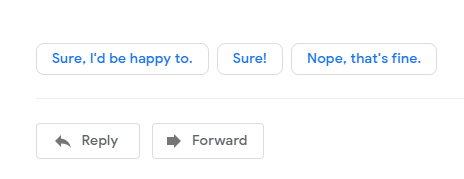
I mean, sure, I am happy for it to suggest answers to a quick question asking for permission to do something. It makes sense that it can understand the context of the question, and know that a quick reply giving assent might be warranted. I am happy with an AI doing that.
What I dont like, is the added exclamation point.
I don’t know why. But I don’t like the AI suggesting excitement. I don’t like it telling me how to feel. I am a contrarian by nature, so perhaps this is just my usual reaction when I am told to act in a certain way, or think a certain thought.
Maybe it also bugs me, because it seems like it would be more fake to send something that presents some kind of emotional response, which wasn’t directly written by me. Passing on a simple ‘Sure’ doesnt have any extra connotations, ‘Sure!’ does.
But maybe, like so many things, I am overthinking it.
Disclaimer: This post isn’t about the efficacy of masks during the pandemic, and I fully understand that not everyone is able, or required, to wear a mask. Its just some thoughts I had about the experience of wearing a mask.
I remember last year I had a bout of asthma. I have been lucky since becoming an adult, as this condition had pretty much settled down, and was kept under control. I still can’t engage in heaps of vigorous physical activity without getting ‘wheezy’, but I can jog, I can climb mountains, and I can engage in Nerf battle with my family; so I have the essentials covered.
But every now and then, it flares up. Nothing major, no attacks that send me to the hospital like when I was a kid. But still enough to knock me out of work, and rob me of a night’s sleep here and there.
It is a feeling that I am still used to; struggling to breath, building up the energy to get up and source my medication. It sucks, but things could be much worse.
You take the time, fight through the breathlessness, find your inhaler, take a few doses, and then sit back waiting for it to take effect. Then you get the glorious feeling of your breath coming back to you. Each breath becomes deeper. The panic leaves your body, and you calm down. After a few minutes, you realise that being able to take deep breaths feels amazing. It’s something that I think those not afflicted with asthma don’t truly appreciate.
Breathing is actually an enjoyable sensation, but as we do it all the time, you lose sight of that. Like chewing gum that has lost its flavour, or the lumpy wallet you no longer feel in your back pocket; it’s always there, you just forget about it.
So when I hear all these people complaining about wearing facemasks because it makes it harder to breath, I can’t help but roll my eyes.
Really?
I don’t know about all you able-lunged people, but yes when I wear a mask for an extended period of time I do start feeling somewhat short of breath (perhaps exacerbated by the fact that I breathe shallower in a vain attempt to stop my glasses from fogging up). But trust me, it pales in comparison to what asthmatics have to put up with, and I don’t even want to think about those suffering from coronavirus.
What’s more, I still get that exhilarating feeling when I take off the mask, and take those first deep breaths. It makes me feel good, it reminds me of how things could be much worse. Hell I even get to feel that smug feeling of ‘doing my bit’, and making a small (very small) sacrifice for the greater good.
(Don’t blame me; it’s how evolution wired our brain).
So next time you are out there in the world, masked up and getting on with life, remember to make a note for when you take off that mask. Take the time to really be in the moment, take off your mask, breath long, and breath deep. Be in the moment and enjoy it. Think about how that little sacrifice can give you a window into what other people are experiencing, and be grateful that the majority of us in society are doing the right thing, and that with any luck this is the worst impact your breathing will have during this pandemic.










 A Moment Worth