Book 12 for 2016: Superintelligence

Book 12 for 2016: Superintelligence
I have had this book waiting in my kindle all year, but it seems so daunting being written by a philosopher, and tackling some heady issues. Thus I had been picking some easier reads instead of delving in.
I have to say though, I do like the grand nature of the issue being tackled. Sure it may sound like science fiction, but if we are indeed working towards artificial intelligence, even a little, then this is clearly an issue, and a possible threat, that we need to be devoting our time to understanding.
So while the book itself may not solve any of the problems it elucidates, indeed many of these problems may never even come to be true, it is nevertheless a worthwhile undertaking simply to try and wrap our heads around the idea of Superintelligence, and how it will impact humanity.
It reminds me of one of my favourite Bertrand Russell quotes, where the philosopher explains why he thinks philosophy is a worthwhile pursuit. It’s worth reading, despite it being one of the largest sentences I can recall reading (it has two semicolons!):
“Philosophy is to be studied, not for the sake of any definite answers to its questions since no definite answers can, as a rule, be known to be true, but rather for the sake of the questions themselves; because these questions enlarge our conception of what is possible, enrich our intellectual imagination and diminish the dogmatic assurance which closes the mind against speculation; but above all because, through the greatness of the universe which philosophy contemplates, the mind also is rendered great, and becomes capable of that union with the universe which constitutes its highest good.” – Bertrand Russell, Problems of Philosophy
#2016inbooks #Superintelligence #ElonMuskWillSaveUs #bertrandrussell from Instagram: http://ift.tt/1Vxft7Y

Sport is Ridiculous; But thats OK

I will admit it: News.com.au is my guilty pleasure website.

It isn’t my go to source for news, despite its relevant moniker; rather it serves as a bit of a relaxing look at whatever craziness is going on in the world, or more generally on the internet.

But I have to say this article on the front page rally irked me:

Now I know this is click bait, and they just want me to open the article so they get their dollars, but having read earlier in the day what the story was about, I was interested to see why they had chosen their clearly mocking tone.For those wondering, the boy had won a drone racing championship.

For those wondering, the boy had won a drone racing championship. Yes those are things that exist, and that you can win money at. You might not be aware of them, but as this article shows, they are apparently a big enough deal to warrant hundred thousand dollar prizes. Even so, just look at how News.com.au presents the story:

Look at the derision in the title; look at how they are belittling this guy’s efforts, and for what? The kid did a good job at flying a drone, but they mock it as if that is no achievement at all. Yet scroll down the page a little and what do you find?

An article about a racecar driver being mistreated. Why don’t they malign the fact that this man is famous for driving his car faster than anyone else?

Go further down and there is a whole section about people who can do mundane tasks better than other people, whether it be running, riding an animal, kicking a ball, or even jumping in the air.

It’s called ‘Sports’.

And just because you don’t find it impressive, doesn’t mean that it can’t be a competitive, skillful and legitimate pastime.

Granted there are more dangers inherent in some sports than others. There is no doubt that being a racecar driver exposes you to more risk than remotely piloting a quadcopter, but I hardly think this risk is what would denote a sport as being worthy of the name. Look at darts, or snooker, or any other sport that requires massive skill at limited personal risk.Really, the author just appears jealous of the fact that this kid has won a large sum of money for something they think isn’t worth it.

Really, the author just appears jealous of the fact that this kid has won a large sum of money for something they think isn’t worth it. Well guess what man; that’s sport. I don’t see why people being able to hit a ball over a net repeatedly should be multimillionaires. But they are, and it’s because people want to watch it happen. I don’t care for it personally, much like I shall never pay money to watch a drone race; but so long as it doesn’t negatively impact on my life too much, I am willing to let it be.

sports

In fact the only time when the capricious nature of athlete-celebrity status really has any impact on my life is when the media hold them up to be role models, and then feign shock at anyone who misses the mark.

So at the end of the day, if we are willing to accept running races, ball games, motorsports, etcetera as legitimate ways for people to not only spend their spare time but also earn a living, then it seems hypocritical to attack others for pursuing their own interests and making money from it.

Let the kid have his day.

MM

Handy Microsoft Word tip plus bonus Imperial Units Rant

I just found this out in Microsoft Word, and it is pretty freaking awesome. If I write something (or more likely copy something) with weird units like miles, or inches, or chains, or whatever; I can get Word to fix this error in outdated units for me. Check it out:

word convert

Just highlight the offending units (including the numbers), right-click, and select the Additional Actions menu. Simple. Click on whatever units you want, and Word will replace the text and you are done. I don’t know why it gives two options which do the exact same thing, but I am willing to ignore the double up due to the sheer usefulness of this feature.

I think this will be most useful when I deal with documents that have temperatures, because Fahrenheit is just plain crazy. With miles at least I can have some sort of idea as it is just a proportion. I know a mile is just over one and a half times a kilometre, so I can get a rough idea.

This however cannot be done with temperature, not only are the units different sizes (i.e. a change of 1°F is different to that of 1°C), but the starting points are all off. When 32° F is mentioned I think, “man; that’s a hot day” (and not just because I am from Ballarat, and anything over 20° for me is too hot), and then I see pictures of people frolicking around in blizzards and make a Jackie Chan meme face.

Jackie Chan Meme

0° Celsius makes much more sense. It is zero degrees; you don’t have any degrees to warm yourself up.

Fahrenheit frustrations aside however, I was amused the other day when Harrison and I were watching a nature documentary set in an Arctic region and the Mighty Attenborough said something along the lines of:

Temperatures here can fall as low as negative 40 degrees.

“Is that proper degrees or Fahrenheit” my son asked.

(You can see that I have indoctrinated him well to my anti-Fahrenheit prejudice when he calls them proper degrees, and not Celsius)

We did our standard Siri-investigation and were surprised to discover that actually it doesn’t matter; -40 Celsius = -40 Fahrenheit. So at least that is one example of a unit in a documentary that is truly accessible to all, regardless of if you use proper units, or imperial monstrosities.

MM

P.s. as an atrocious speller, I have to point out that Fahrenheit , like manoeuvre, is a word that I struggle so hard to spell that even my best attempts leave spell check unable to understand what it is I am trying to say.

2015 in Books

File_000

This year I read 20 books. To some people that sounds like a lot, to me it is nowhere near enough (especially when you consider the fact that I purchased 51 books this year!). I had initially planned to ape Mark Zuckerberg’s year of books, but found it a bit hard to keep to the fortnightly goal of finishing a single book. Some of the books I read in 6 days, others I slogged away at for over 40 days, but on average I finished a book every 17 days.
So I figured I would keep a bit of a rundown of what I read here for future reference, and also to hopefully track my ever increasing number of yearly book reads. I initially ended up churning out pages of commentary, but I figure I’d be best to keep it to a couple of sentences for brevities sake, and perhaps one day I will flesh out some of my other thoughts into beefier posts.
Also, before I get onto the individual books themselves, I was surprised to notice that there was pretty much an even split between physical books, and books on my kindle, so I shall present them as such:

The Physical Books

Hard Rain by Barry Eisler

The first book in the John Rain series about a Japanese-American assassin who specialises in making his kills look like natural causes. Great series of books for when you want some cool action/assassin/spy thrills. The writer is very knowledgeable, and you end up having a greater understanding of how to perform surveillance runs, fight hand-to-hand combat, and enjoy a delicious single malt whisky.

4 out of 5 totally unsuspicious heart attacks 

The Sixth Extinction by Elizabeth Kolbert

An amazing book, I feel I have a whole blog post waiting inside me to praise this book, so I won’t waste my time on that here yet.
The Sixth Extinction is the one we are living in right now, it is global, it has been going on for thousands of years, and it is being caused by us. This book goes over the previous 5 mass extinction events, but it also gives a fascinating outline about the latest extinction event being cause by humans (both present, and Palaeolithic).
I initially shied away from this book when I first noticed it popping up on peoples must-read lists back in 2014 because of its slightly depressing nature (much in the way I have yet to find the time or emotional energy to watch Blackfish or The Cove). I knew humans were causing mass extinctions, but I didn’t want to be overwhelmed with the reality of this.
I have to say though, I am glad I read it, and though it may be bleak to realise that you are a member of a species irrevocably altering life on earth, I think it is an important duty that we learn all we can about these extinction events if we ever hope to try and alter our planets future in a more positive way.
5 out of 5 species lost to the ages

Redshirts by John Scalzi

I had heard a lot about this book in the past, and then this year John Scalzi was all over the Internet with his ## million deal with Tor books. So I figured it was time to check out some of his work, and I was not disappointed. How has this book not been made into a film yet?
For those not in the know, a redshirt is the unofficial name given to those extras in Star Trek who always went along with the main characters on dangerous trips to other planets, only to be killed in some way that furthers the plot. This book is about a bunch of these redshirts on some futuristic ship, who start to realise their predicament as ‘extras’ in some mysterious narrative, and begin to do something about it.
Many thumbs up, have ordered Scalzi’s Old Man’s War, which is apparently some of his best work. Will report back next year…
4 out of 5 dead crewmen

Ancillary Sword and Ancillary Mercy by Ann Leckie

These two books for the latter part of a trilogy that I began last year after again hearing praise for the book all over the place. I don’t know how much detail I could go into with these stories because the world is so intricately made, and the characters so complex and fascinating, but perhaps the best way to get people interested in reading these books is to point out that the main character is a soldier who used to be a starship, and who is seeking to get revenge on the galactic dictator who killed her previous captain, and who is currently at war with various versions of herself.
Bam; read it!
4 out of 5 confusing pronoun uses (did I mention that, regardless of sex, characters all have the female pronoun?)

The Mechanical by Ian Tregillis

Set in an alternate world where the Dutch achieve near global hegemony due to their alchemical invention of clockwork automatons called clakkers. Their only opposition comes from a moribund French republic, fighting back from their last stronghold in Canada. The brunt of the book deals with a clakker who accidently finds itself imbued with the ability to exercise his own free will, and is then subsequently on its mission to escape the Dutch, and help free its fellow clakkers. There is also a hint of body horror that must be read, and some cool intrigue courtesy of the French spymaster (who has the cool sounding title of Talleyrand).
4 out of 5 sentient beings
(P.s. the book comes with red lined pages, which at first I thought looked cool, but then after losing minutes of precious reading time playing around with the various shades I could make by twisting my books pages, I soon realised I shouldn’t be near colourful things when I want to read.)

Emergence by John Birmingham

An ‘action-movie waiting to happen novel’ where a deep sea oil platform accidently cracks through the earth’s crust, letting lose a horde of orc like bad guys. Luckily an oil rig worker accidently receives super-powers after killing one of the beasts, and now sets about saving humanity.
An alright read for some quick action, but if you want a good book by John Birmingham I recommend his Axis of Time trilogy, about the repercussions when a futuristic military fleet is accidently transported back in time to World War II. Come for the awesome action involving futuristic weapons fighting Nazis, stay for the social commentary as modern values clash with 1940’s folksy racism/sexism.
3 out of 5 enchanted splitting mauls

Armada by Ernest Cline

When a gamer starts noticing the alien spacecraft from his favourite game flying around his local neighbourhood he firsts thinks he is insane. We then learn that all of pop-culture alien invasion stories have been secretly preparing humanity for an incoming invasion, and our main character might just be the guy to save the day.
This book was a nice little escape from reality, but it inevitably falls short to the expectation that Cline’s first book (the amazing pop-culture/virtual reality extravaganza that was Ready Player One) had brought to bear. The story is entertaining enough, but feels rushed, and could have benefited with letting the story grow more.
3 out of 5 space invaders

Sapiens by Yuval Noah Harari

The name of the book perfectly matches its scope as the author takes a step back and attempts to give a grand view of the history of our human species. Starting off from our emergence hundreds of thousands of years ago, chronicling our interaction with the other members of the genus homo, and then driving through our long history from hunter gatherers, farmers, industrialists and so forth until it bring us all the way to you and me; the current line up in billions of progressive human individuals.
I found this book tied in well with a couple of other reads this year in that it helps me to get a better understanding of where I fit in the world, and what I want to get from life. This books does a great job of explaining how I got to where I am as a member of the human species; now what am I going to do with the world I have inherited?
5 out of 5 wise apes

The Innovators by Walter Isaacson

Chronicles the advent of the computer age, starting way back when Babbage and Lovelace started tinkering with the idea of a computer, stopping every step along the way (from enigma cracking machines, the development of coding languages, the invention of operating systems, the development of transistors, the birth of the Internet; literally every step of the way!), right up until Google and Wikipedia changed the way we accessed knowledge forever.
A great read if you want to understand a bit more how we managed to turn some clanking gears and the abstract idea of a computing machine, into the interconnected world we have now. Explains the concepts in a simple enough manner, but also gives a great introduction into the people who made it happen, and the worlds that they made it happen in.
4 out of 5 innovative geniuses

The eBooks

The Circle by Dave Eggers

The Circle imagines a future where one Internet company gets so powerful, and becomes such an integral part of our daily lives, that it essentially ends up taking over large parts of who we are. Almost an attempt at a modern 1984, with a Google/Facebook mash-up as the sinister Big Brother, whose constant surveillance and demands for compliance eventually convert the main character in a Winston Smithish fashion. It’s a tale that was ripe for the telling as social media continues its inexorable charge into our lives, and though I found the world it created interesting, I think it didn’t present it in a convincing enough way. This is the kind of book where I wanted to argue with the main characters because there wasn’t enough of a dissenting voice in the story that I could hitch my wagon to.
3 out of 5 status likes

Moon for Sale by Jeff Pollard

Sequel to the first Kindle book I ever read. The story follows a character modelled on Elon Musk as he continues his quest to colonise space in competition with the sluggish government bureaucracies.

This is a good read if you like the technical details of space exploration (which I do). But the author is still finding his feet, the book needs some more editing, and the overall feel is a bit amateurish.

Lots of potential and I am invested enough to be looking forward to the next in the series, but this is more of a guilty pleasure for myself than it is a book I would recommend to others.

3 out of 5 thinly veiled references to real life Elon Musk facts

Elon Musk: How the Billionaire CEO of SpaceX and Tesla is shaping our Future by Ashlee Vance

This year my Musk fandom sky-rocketed like one of his falcon rockets! I can’t get enough of this guy, and his amazing plans for the future. He builds rockets, electric cars, solar utilities, ponders the danger of artificial intelligence and suggests plans for things like a Hyperloop. I am a massive Musk fan, a Muskiteer, and this book only added kerosene to the fire (kerosene is the fuel they use in SpaceX rockets after all….).

If you want a primer on all things Musk, this book is a must read. It chronicles his whole life, from a boy in South Africa, his move to America, funding of his initial start-up, then the multi-million dollar sale of PayPal, and on to his current ventures with Tesla (electric cars) and SpaceX (the eventual colonisation of Mars). More important however is that it shows you a bit of how Musk thinks, and what his plans are; and trust me, these are fascinating topics.

5 out of 5 Mars Colonial Transporters

Nexus by Ramez Naam

A cool science fiction story set in a not too distance future where an illegal drug allows some hackers to enhance their minds. It’s cool seeing how a hacking could be applied to the human mind, like when a character creates a program to help him keep his cool in tense situations, or boots up a protocol that allows him to bust Kung Fu moves on his would be attackers. And of course there are attackers because the story quickly has our hero being busted by the government, and then sent on a mission with a similarly ‘enhanced’ secret agent to spy on a mad scientist, blah blah blah. An enjoyable story that I had forgotten I read, but remembered that I enjoyed.

3.5 out of 5 cyberpunks

Aurora by Kim Stanley Robinson

I already wrote a bit about this over here, so I won’t go into much detail. Suffice to say I love all things Kim Stanley Robinson’s, and this was no exception.

Set on the tail end of a generation ships journey to Tau Ceti, the book deals with the realities of keeping a society functioning on a starship over hundreds of years, how that impacts on them, and the challenges they must face.

5 out of 5 regressions toward the mean

Parasite by Mira Grant

An interesting story about a future where people swallow genetically engineered tapeworms as a means of controlling their health and medication. But of course something starts going wrong, and soon people are being taken over by a ‘sleeping sickness’ that may or may not be the tapeworms taking over.

I enjoyed this book, but it took a while to reveal its big twist, so by the time one of the characters finally said what we were all thinking, it had become painfully obvious. Also, this is the first in a trilogy, and it really felt like it.

3 out of 5 medication excreting tapeworms

The Compassionate Carnivore by Catherine Friend

This book is exactly what I have been looking for for a long time. I have always been conflicted when it comes to eating meat. I love animals, and I believe that it is cruel to keep them in cages their whole lives, and then slaughter them just to eat their flesh.

But on the other hand; hamburgers. And Pizza, and bacon, and spaghetti bolognese! I can’t give these things up!

The good news is, don’t have to. I don’t have to be a vegetarian. I can accept my place in the food chain as a compassionate carnivore.

This book taught me a lot about how animals get from pasture to plate, how they should be treated, and more importantly, how they shouldn’t be treated. It taught me that yes I can eat meat, but I need to be conscious of where it comes from. I can eat meat, but only from humanely cared for animals. I can eat meat, but only in appropriate portions.

Of all the books I read this year, this has had the biggest influence on me. Yes I still struggle with the moral implications of eating meat. But now at least I feel like I have educated myself on the problem. I am more considerate of my actions, and how what I choose to eat affects others, in particular the animals themselves.

The book is written by a lamb farmer, so she knows her stuff and is by no means preachy. I encourage anyone who eats meat to give it a read.

5 out of 5 grass fed steaks (with no added hormones or antibiotics)

Short, Sharp Shock by Kim Stanley Robinson

Kim Stanley Robinson’s only foray into fantasy writing (unless you count the Buddhist reincarnation bits from The Years of Rice and Salt) follows the story of a strange who washes up on a beach with little memory of who he is, or where he has travelled. He follows the coastline of a seemingly planet spanning peninsula, and encounters a lot of weirdness along the way.

An interesting read, but unlike all of Kim Stanley Robinson’s other stuff, I don’t feel like I have taken anything away from this story. It was entertaining, yes; but it didn’t teach me anything new, It didn’t make me think about anything in a new way, it didn’t broaden my horizons to anything that is real. Though I suppose this is more of a disconnect with me and the fantasy realm, than it is a criticism of the book itself.

3 out of 5 men with small apple trees growing on their shoulders

Luna: New Moon by Ian McDonald

The moon is colonised in the not too distance future, but it is an ugly place. Five massive families/corporations have a hold on the moon, and battle it out Game of Thrones style, complete with knife fights (there are no laws on the moon except contract law, so trial by combat is still a thing), and forced marriages. The story follows one of the ruling families, the Cortas’, who mine the lunar soil for Helium 3.

A great bit of hard sci-fi, with entertaining characters, and a fully realised lunar society that appears completely believable, but utterly alien; just like good sci-fi should.

4.5 out of 5 low gravity knife fights

Homo Evolutes by Juan Enriquez and Steve Gullans

Ok, yes, you got me; I cheated. I used this little TED book to make my 19 books in 2015 become the more rounded 20 book sin 2015. Sue me.

Homo Evolutis is the name of a hypothesised new species of human that is coming about due to many changes currently under way across the world. Changes ranging from elective surgeries, gene therapy, cultural changes. Blah blah blah.

This book was interesting, though I wouldn’t really consider it a book. More of a transcribed TED talk with copious references. Now this isn’t a bad thing; I enjoyed reading it, and got a lot of information from it. But I still don’t feel entirely comfortable listing it as a book I read. So instead I will finish my list with:

Call back from 2014

Galileo’s Dream by Kim Stanley Robinson

I started reading this book in 2014, got through the first few chapters, and then it got lost in the mix somehow until I fund it again in February, 2015. Given the fact that I have blogged about Kim Stanley Robinson in the past, and two other books of his appear on this list, you may have figured out that I am a fan.

At any rate, this novel is set simultaneously in the past, and in the distant future, as the famed scientist Galileo Galilei is flung back and forth through time to help solve the scientific and moral conundrum facing people living on the moons of Jupiter. I was initially sceptical about this read, as half of it seemed historical fiction. But it was actually great to be able to read about Galileo, and how his scientific mind worked back before a lot of the tools we had today existed.

4 out of 5 Papal betrayals

In Memory of Those Who Didn’t Make It

Each year I start more books than I finish. I usually also buy more books than I start. It is a viscous cycle, but I like to think that I am just failure proofing my reading ,so that if there is ever a catastrophe and I lose my income, I will still have a bookshelf of new reads awaiting me (now where I could house that bookshelf is another question).

This year I bought approximately 51 books, here are those that I failed to fit into my reading:

  • Mr Holmes
  • The World until Yesterday
  • The Hour between Dog and Wolf
  • The Moral Lives of Animals
  • Scatter Adapt and Remember
  • Ghost Flight
  • The Dispossessed
  • Railsea
  • My Beloved Brontosaurus
  • In The Heart of the Sea
  • The Lagoon
  • Joseph Anton
  • An Astronauts Guide to Life on Earth
  • Why the West Rules For Now
  • Reamde
  • Future Babble
  • The Lab Rat Chronicles
  • The Spy
  • An Appetite for Wonder
  • Leviathan Wakes
  • The Second World War
  • Threat Vector
  • Seveneves
  • The Knowledge
  • Superintelligence
  • Solving the Procrastination Problem
  • Crux
  • How We’ll Live on Mars
  • The Three-Body Problem
  • Thinking about it Only Makes it Worse
  • Wired for Love

Let me know any thoughts you have on these books, or books that I should add to my list for this years reading.

Cheers,

MM

Quick thoughts on the latest Star Wars: The Force Awakens trailer

MF

Man; I am excited about this film. Even though this trailer give me no idea of what the storyline is going to be; it still somehow reassures me that this film is going to be true to the Star Wars world.
How can a Star Wars fan not be excited about this trailer, and thus about the upcoming film? The visuals, the music; the Han Bloody Solo!
Yes a lot of us remember the prequels being a bit of a let-down, and therefore are doing our best to not throw our hopes as high as they may have been in 1999. But I can’t help feel that here are a few legitimate reasons to be optimistic for the new trilogy.
First of all, I have faith in J.J. Abrams. Excessive lens flare aside, I think the man tells a great story, is able to make interesting characters (Jack Bristow FTW), and in general makes entertaining films. He is able to capture the essence of the stories he sets out to tell.
Second, we have enough from the old Star Wars trilogy to make it feel familiar. And I don’t just mean Ford, Fischer and Hamill; Lawrence Kasdan is back as co-writer. In case you don’t know, he was the co-writer of Empire Strikes Back, arguably the best of all Star Wars films.
Plus if The Force Awakens is a good film, then it means the majority of Star Wars films are good films, regardless of what you think of the prequels.
But having finally seen the trailer (as thin on actual plot details as it may be), I think I can see the way that Abrams will be taking this story; and I like it.

its true

All of it

What I take from this trailer is that The Force Awakens will be a story about the Star Wars story itself. A kind of meta self-referential tale about the power of the Star Wars story.
Star Wars casts a big shadow not only on science fiction films, but on film-making itself. It opened up a whole new way of telling stories, and inspired a new generation of directors. Directors like Abrams himself.
Abrams has long been a Star Wars fan; in fact I remember an interview with him upon the release of his reboot of Star Trek where he talked about not knowing much about Star Trek, and being more of a Star Wars fan.
In his film Super 8 Abrams gave us a movie that was as much about film-making itself as it was about an alien stuck on earth. Many claimed it was an homage to Spielbergian film-making (which I can see), but it was also a story about making films, and I think this is an example of how Abrams is able to convey a sense of awareness in his filmmaking. He understands where these films fit into the public’s perception of them.
So naturally when tackling one of the biggest film franchises of all time, he knows that there is a lot of history surrounding this, and that the fans of these movies are a part of that. The story of Star Wars has been around for almost forty years after all, so it has had plenty of time to have a life all of its own, and to pervade the way we think and feel about other stories.
This brings me to, in my opinion, the most interesting part of the trailer  (narrowly edging out the lack of Luke); this exchange of words:

Rey: There are stories about what happened.
Han Solo: It’s true. All of it. The Dark Side. A Jedi. They’re real.

You can hear in her voice, in the way Rey talks about these stories, that there is a power in such tales. It is this talk of stories that to me explains the direction this movie may take.
The Star Wars world in these new movies is almost a parallel of our own. Indeed the passage of time between the original trilogy, and this new series has taken place in real-time, so the memories of what happened in those movies is comparable to the memories of those movies for us here in the real world.
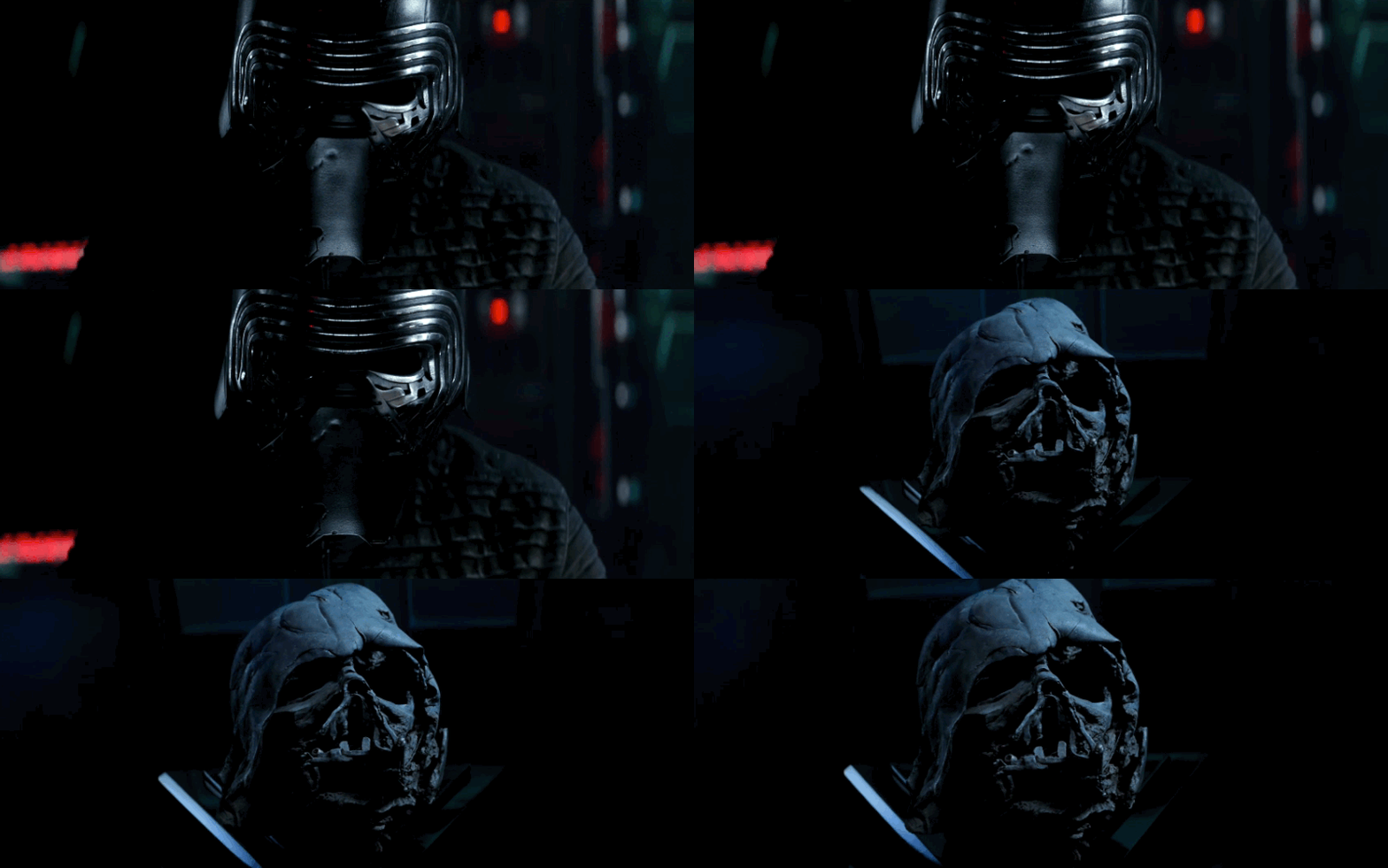
The power of the stories people told of the downfall of the Empire mirrors the power of the original Star Wars trilogy for us, the audience. The story of old glories come back, of the power of past experiences, rings true regardless of whether you are a character reacting to them, or an audience member reliving them. Even the films new villain, Kylo Ren, appears to mirror the public’s obsession with the classic villain Darth Vader, as he seeks to ‘finish what [he] started’.

vader fan
So perhaps this Star Wars will be a story about the story of Star Wars; about the power it has over people down the generations. It will be a tribute to Star Wars, as it very well should be.

Quick breakdown of other thoughts from the trailer;

  • Number one; where is Luke! Clearly there is a reason Luke isn’t being shown (beyond a pat on R2-D2’s head. Maybe how he looks will give something away (has he turned to the dark side?). Or maybe he simply isn’t that main of a character. After all he is also absent from the poster.

Rey explore

  • Rey’s travels through the ruins of derelict Empire starships just looks awesome. (P.s. when she is watching that ship fly off into the distance, there is clearly an AT-AT foot at the bottom of the frame, which is suggested to be where Rey lives)
  • The music in this trailer is awesome. Going to be great to hear John Williams on the big screen again.

battle

  • I like that we see Finn wielding the Skywalker lightsabre, yet I can’t help but worry that he is going to have his arse thoroughly handed to him by what appears to be a more sabre competent Kylo Ren. Unless there is going to be some awesome Jedi training montage in this film (seems unlikely), then this looks to be quite the mismatch. So either someone will come along and save Finn, or perhaps Kylo is more interested in collecting another Darth Vader icon than he is in disposing of Finn.
  • Speaking of Finn and Rey; what are their last names!! I can’t help but feel that at least one of them is being kept under wraps due to it being excitingly familiar (and familial).
  • Not much captain Phasma in this trailer.

air battle

  • Lots of awesome looking battle sequences though.
  • Lens flare.

kylo

  • Kylo Ren and his band of masked bad guys in the rain. And I don’t care what people say of its practicality; that red cross-guard lightsabre is awesome.

Finn down

  • Voiceover from Finn seems to lend credence ot the theory that he is a storm trooper who becomes disillusioned with the First Order after taking part in, or witnessing a massacre. Sure looks like he escapes in a TIE fighter and is shot down by a Star Destroyer over the junkyard planet of Jakka (soon to meet Rey no doubt).

MF2

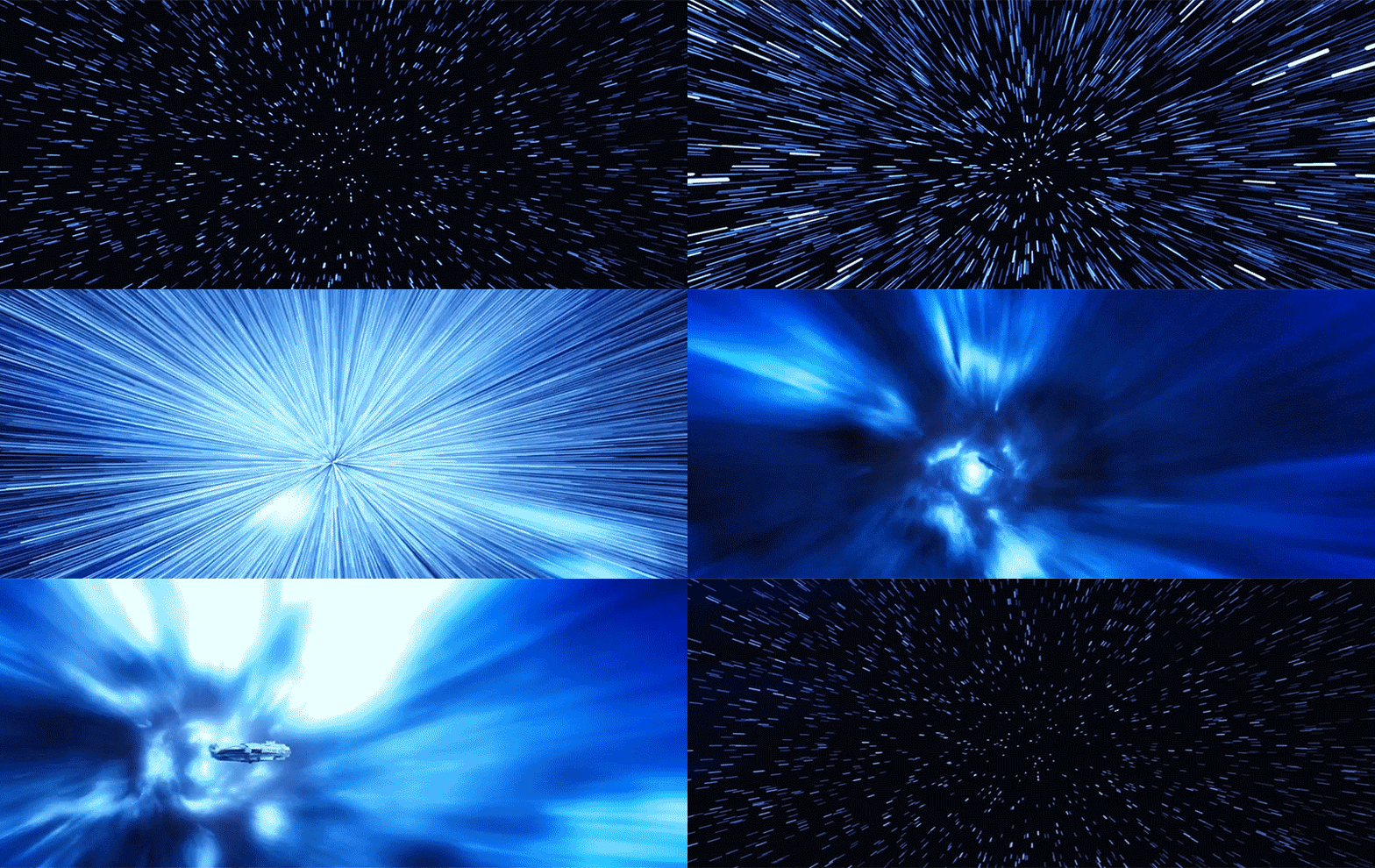
  • Millennium Falcon. Millennium Falcon! MILLENNIUM FALCON!!!!
  • People a long time ago, in a galaxy far far away, clearly have terrible memories. They don’t know about the Jedi, or the dark side? Much like these people seemed to have quite quickly forgotten about the Jedi and the power of the force in the original trilogy. Han Solo may just have no interest in history when he says “I’ve seen a lot of strange stuff, but I’ve never seen anything to make me believe there’s one all-powerful Force controlling everything.”, and perhaps when Motti references the Force as an ‘ancient religion’ he just forgot about the whole Jedi Council that existed a couple of decades previous. But it still seems odd that a civilisations collective memory could be so forgetful; its like people being shocked to learn that Nazis were real things, or that there used to be this thing called communism.

Some of My Investing Wisdom for This Tumultuous Time

/*Disclaimer – I am in no way offering the below as actual financial advice. If you are devoid of a sense of humour, or lack the gene required for detecting sarcasm; please dismiss the following post as the ranting of a unstimulated mind.*/

There has been a lot of talk of share market crashes and billions of dollars in value wiped from investor’s pockets of late, so if you are a potential investor or already have your own portfolio, you might be a bit distraught over what is going on.

For those of you worried about the share market I am here to tell you it’s time to relax! I am a market veteran (been buying shares for what must be months now), so here are a couple of tips and expert advice in handling investor anxiety.

Tip No. 1: Invest in crazy shit like salmon farms and electric cars.

If you do so, your shares will go all over the place all of the time, so when the market crashes it doesn’t affect you, because you are already used to sudden and devastating losses in your portfolio. I recently invested in a salmon farm and a company that does aerial photography. The share prices almost immediately went down (market analysts out there take note; your best indicator of a share about to plunge is simply whether or not I buy it). Down, then slightly up, but always down a bit more the next day; like a poorly flung yoyo. I can’t even remember what initial price I got half my shares at because their current values are so disparate from their originals that any sense of loss I have is numbed to a pleasant tingling sensation in my wallet.

But perhaps you are someone who is a bit more attuned to their personal wealth; maybe you like numbers, and such a slide in your personal wealth will be noticed, and slowly niggle away at your mind. Fear not; I have more investing techniques up my sleeve:

Tip No. 2: Buy international shares.

International shares help muddy up the waters when you want to understand (or be ignorant of) just how much money you have lost. They do this through the magical financial multiplier known as an ‘exchange rate’. Exchange rates tell you how much of some other form of money, your current form of money used to be worth, before it inexplicably declined in value. Thus if you buy international shares, the exchange rates distort the numbers; sanding away the rough edges of a market slump so that you are left with a roughly hewn “I guess I haven’t lost that much” attitude.

I bought Tesla Motors stock eager to be a part of the coming Electric Car Golden Age™, safe in the knowledge that Elon Musk would launch us into the future like one of his SpaceX rockets. Perhaps I should have taken into account that SpaceX’s rockets are striving to be reusable, so while they may soar to impressive heights (Tesla stocks had an all-time high of $291!), they also like to frequently return to their earthly lows (as of this moment, they are sitting at what I hope is a launch pad level of $220).

But the beauty of all this is that though my shares have in a sense lost value, that value isn’t something I can easily picture in my mind; it’s not like when my Nearmap shares went down $50, and I could taste the loss as a bottle of scotch I never got the chance to buy. Because my stocks are from the United States, I first have to try and remember what Australian dollars I spent on them, then how that converted into US dollars at the time, then how much the strength of our currency has changed since, and thus what these American dollar stocks would be worth if I sold them and recouped my losses in Australian dollars at the current exchange rate. I am sufficiently confused just writing it down!

They say you have only lost money on the share market if you get scared and sell your shares at lower than you bought them. Thus the foggy nature of international shares helps you to not even understand what your balance sheet looks like, which reinforces the deeply engrained aversion to action hidden away in our ape brains by evolutions invisible hand*. This in turn stops us from being a slave to the impulse to sell brought on by doomsday headlines and sensational talk about ‘financial crises’.

For those of you still sceptical, I will finish this post by leaving you with one last reason to buy international shares; because in America they are called stocks. Not only does that sound cooler^, but what you wily investors will now have is two portfolios; a stock portfolio, and a share portfolio. That’s not just diversification of companies, or industry types; that’s diversification on a thesaurus level.

MM

P.s. The above post is quite tongue-in-cheek (whatever that means), and I am actually quite happy with my share picks this year (just not at this particular point in time).

*Note: Not Adam Smith’s invisible hand; that’s another story.

^ You can check the comparative coolness of words here: https://books.google.com/ngrams/graph?content=stockmarket%2Csharemarket&year_start=1800&year_end=2000&corpus=15&smoothing=3&share=&direct_url=t1%3B%2Cstockmarket%3B%2Cc0%3B.t1%3B%2Csharemarket%3B%2Cc0

Why is Active Camouflage Less Prevalent in Terrestrial Animals?

Just one of the random questions I come up with throughout my daily life. Figured i would put it up here, and on Quora, and see if i could enlighten myself, and perhaps others.

I was watching an episode of Deadly 60 with my family when it highlighted yet another underwater animal that could actively change the colour of its skin to fit into its environment. I have always been a big fan of Cuttlefish for their colour and texture changing abilities, and was only recently (5-years-ish) made aware of how well octopuses can accomplish the same feat. But when it come to terrestrial animals, there doesn’t appear to be as many examples. There are Chameleons, Anoles, some frogs and thats really it, at least as far as a quick Wikipedia search can tell me.

Whats more, land based colour changers don’t appear to have the same standard as their waterborne kin. Cuttlefish can change their colours seemingly instantly, they use the pulsating colours across their skin to communicate, and can contort their bodies and the texture of their skin to complete their illusions of camouflage.

When camouflage fails; dazzle time

When camouflage fails; dazzle!

So I was wondering; why is this? Is there any biological benefit for a watery environment when dealing with active camouflage, or is are there differing evolutionary pressures that make it harder to adapt on land? Perhaps the mechanisms used to change the pigment cells in water based cephalopods doesn’t work well in the dryness of the land, or maybe the ocean bed is simply better suited for mimicry than the world above.

I don’t know; but I would be delighted if someone could enlighten me.

Cheers

P.s. One more awesome GIF for the road:

When people start talking AFL at work, I wish I could do this...

When people start talking AFL at work, I wish I could do this…

Parental Guidance Recommended –Reflections on determining what’s suitable for my son

I went to the movies recently to see Marvels latest outing; Ant Man. I was thoroughly impressed with the film, but as I was watching it I noticed that a new thought process was taking place in the back of my mind. Not only was I suspending disbelief, and trying to keep track of plot lines, or character arcs (or as this was a Marvel film; keeping an eye out for Stan Lee); but I was also evaluating the films suitability for my son.

It was strange, as this wasn’t as intentional as it had been when my wife and I had gone to see Jurassic World recently. Being true to the 50% of his genome that I contributed toward, my son is a massive dinosaur nut, so when the latest addition to the Jurassic Park franchise was announced, he was naturally interested to go. I wasn’t so sure however, as though he is 9 years old now, he can still be sensitive to the content of movies.

So  knowing this, when recently he wanted to watch the original Spielberg Jurassic films I was sure to watch them along with him, and made sure he was aware of any possibly disturbing upcoming scenes. Yes we may be sheltering him a bit, but it seems preferential to be involved in his viewings of such things, rather than let them go into the wilderness alone and possibly see something potentially disturbing (as I did when an aunty hired Watership Down for me, thinking it was a kids film, and left me unattended to bear witness to the horrors within).

Indeed a lot of my thoughts on this stem from my own childhood. When I was a lad and attended the premier showing of Jurassic Park at the cinema, I was unduly terrified of what I might see, as I had read the book beforehand to prepare me. The thought of seeing Nedry’s intestines spilled into his hands, or Henry Wu’s ripped out of his body, kept my hands firmly placed over my eyes for all of the famous death scenes. No surprise then that years later when I rewatched it I was surprised at how tame the scenes were, and how much worse I had imagined them. But I still wanted to make sure that my son was properly prepared for what he was going to see. It is after all a PG movie, and I am the P, so might as well do the G.

So for instance when Nedry was going to be killed, I let him know; when a lawyer was going to have a bad time on the toilet, he was fully informed. He handled it all well enough; was amused at the demise of Genaro as so many are, and generally wasn’t fazed by the experienced (in a negative sense anyhow; he loved the film. Next stop: The Lost World.

Again I was cautious, because though you don’t see that much direct carnage in Jurassic Park, the fate of Eddie Carr in The Lost World seems far more graphic. Again I prepared my son, told him what would happen and so forth, he was willing and excited to see it, and after the Rexs had had their meal, he was relieved and all was well. So I figured, hey that’s good; worst part of the movie over.

I was wrong.

I gave cursory warnings for what was going to come. Raptors killing people in a field; all good. T-Rex chomping a guy through the waterfall; he can handle it. However I was a bit surprised when the lead up to Dieter’s death was interrupted by a distraught look on my sons face (my wife on the other hand was more on the ball). At first I thought he was reacting to the frightening visuals of a man being swarmed by a flock of tiny dinos, but it turns out he didn’t like the bit where Dieter grabbed one of the compys by the neck and appeared to be strangling it!

We had a similar start many years before when a strangulation scene in Journey To the Centre of the Earth affected Harry more than anything else had (he had even been fine with Donovan disintegrating into dust in The Last Crusade, and the Nazis heads exploding and such in Raiders of the Lost Arc). So after this movie experience was over, we started to get a better idea of the things that bothered him (the repeated stomping of Carter was likewise not well received).

Women getting strangled, animals getting hurt, and protracted death scenes seemed to be the main causes of concern.

So armed with this knowledge, and aware of his excitement at the release of Jurassic World, my wife and I decided to evaluate its suitability for him when we went to see it.

*Spoiler Alert*

It didn’t take us long to come to a conclusion; this was not for Harry!

Women getting strangled/protracted death scene; the demise of Gray and Zach’s minder seemed very excessive, and not the best thing for a young kid to enjoy (you are almost relieved when she is put out of her misery!). But more to the point; the heartbreaking scene of the Apatosaurus death was definitely something we didn’t want our son to get upset about.

He is a caring boy, and he gets emotional as a result; it is a quality that I admire in my son, though it can be hard to deal with some times (like for instance when he questioned the right that my wife and I had to kill a plant that was entangling our fence, and grieved its loss).

Harrison was not very pleased when we informed him that Jurassic World was not a movie he would be seeing at the cinema, but he has accepted our reasoning, and we are glad that he is able to understand the motivation behind it. Furthermore my wife found a junior novelisation of the film for him to read, and he tore through it with vigour.

In previous times when we had warned him at the graphic nature of some movies and shows he would seek to allay our fears us by saying stuff like ‘Nah I’m fine with that. I have watched a bunch of murder shows with Pops; it doesn’t bother me’.

First of all, by ‘murder shows’, he means stuff like Foyle’s War and Poirot. Secondly we explained to him that we don’t want him to be ok with stuff like murder, rather we want him to be able to process it appropriately. Again he generally understands our views with stuff like this and begrudgingly accepts our parental censorship.

Now then, before this post gets too out of hand; back to the initiator of this post: Ant Man.

Sitting in the cinema, I became aware of how much I was evaluating scenes in terms of whether it was suitable for Harrison. It wasn’t at the front of my mind; I wasn’t doing it on purpose, or spending the majority of my focus on it. But I did notice that after a scene had taken place, be it a fight, or a death, or a adultish joke; I would think to myself ‘Yeah I think that’s ok for Harrison’.

It is interesting to note how little mental processes like this begin to form when you become a parent.

For example, I like to swear a bit in my casual voice. I don’t think I am an overly explicit person, but I like the emphasis afforded to English’s most versatile word, and if someone like Stephen Fry can extol the virtues of using the odd swear word now and then, I think I am in good company.

“Swearing is a really important part of one’s life. It would be impossible to imagine going through life without swearing and without enjoying swearing… There used to be mad, silly, prissy people who used to say swearing was a sign of a poor vocabulary -such utter nonsense. The people I know who swear the most tend to have the widest vocabularies and the kind of person who says swearing is a sign of a poor vocabulary usually have a pretty poor vocabulary themselves… The sort of twee person who thinks swearing is in any way a sign of a lack of education or a lack of verbal interest or -is just a fucking lunatic” – Stephen Fry on the joys of swearing

Nevertheless once my son got to an age where he would comprehend, and repeat words; it was clearly something that had to change. However I wouldn’t say that this change was an overly conscious decision; rather it just took place, and I noticed it at a later date. Suddenly I was like ‘Shit; you know what? I don’t swear that much at home anymore.’ Perhaps this is an easy switch to make, because I had already cultivated a mind that at a younger ages ensured that I didn’t swear around my parent, but still had sufficient four letter words when amongst friends.

At any rate, this was just a bunch of thoughts that entered my head recently, and I thought it might be interesting for anyone that has kids, or watches movies, or simply likes to read words online.

Feel free to let me know what you think in the comments; that’s why they are there.

Cheers,

MM

*Spoiler Alert*

Oh, and for those wondering, the worst things you will see in Ant Man involve people, and in one case an animal, being shrunk down unsuccessfully to that all that remains is a small blob of flesh and blood coloured gloop.

Some thoughts on Kim Stanley Robinson’s work

Kim Stanley Robinson is the author who I would say has had the most influence on my life.

I got into his books when I was young enough that a lot of what I read I didn’t really understand. The psychological representations in Red Mars left me confused, the eco-economics and gift economy went over my head, the idea of social revolution, of building a new society free of the ‘straightjacket of history’ was fascinating, but much of the more complex themes in the book generally left my young mind perplexed (not to mention the sometimes very explicit sex scenes).

But I thoroughly enjoyed the book, enjoyed reading a science fiction story that felt more like a history book transported back in time from the future, and less like a fantastic tale of make believe. It felt real, and it was simply transformative. It helped me form a lot of the ideals and principles that still hold fast in my mind today. It gave me a way to see the world as an adult, when I was still just a kid.

Indeed it was only last year that I took it upon myself to read the Mars Trilogy again, and was shocked at how much of what I thought of the world seemed to have been ignited by that story over 19 years ago. Though while the Mars trilogy is by far my favourite of KSR’s tales, his other offerings have also left undeniable imprints on who I am.

The Science in the Capital series drew my attention to game theory, the idea of a paleo lifestyle, thoughts on how we could impact our world in opposition to climate change, and a better understanding of how other cultures ways of thinking could be incorporated into our own. It was also nice to have a protagonist who was an attentive father (which at the time I was attempting to become).

The Years of Rice and Salt was an eye opener in that it showed a world free of the cultural lens that I had viewed it through for most of my life. Reading an alternative history without a western civilisation, but still with tendrils of parallel events, experiences and social progress flowing within, helped me to understand history a bit better, and to seek out an understanding of how the world came to be as it is, and how those living at certain times may have faced the challenges of the world.

Overarching themes in Robinson’s works also embedded themselves in my mind.

My first exposure to Arab culture as a young man came through the Mars Trilogy, and then in a post 9-11 world it was fascinating to read about an Islamic world in The Years of Rice and Salt, and to be presented with compelling characters, thoughtful ideas, and a new way to view Islam; all much more interesting than the caricature of Muslims that became so prevalent in those years (and even now).

Forty Signs of Rain introduced us to a protagonist who liked to examine the world through the prism of the savannah, and the human races evolutionary origins; using game theory and sociobiological tools to understand how modern humans are a result of prehistoric human’s journey through time. Then Shaman completed the notion by giving us a first-hand account of how life may have been for those humans who were genetically so like us, but whose lives seems to disparate from what we consider a human existence today. So different, yet still so similar.

His novels are also interesting to me in that they offer me a chance to see the world through different eyes than a lot of other science fiction experiences (especially moves and TV) commonly available. Being a white male from a western society, it is easy to find characters I can seemingly identify with, but that connection always seemed so superficial. In Kim Stanley Robinsons works I was able to identify with characters from wildly different backgrounds than my own.

The Mars Trilogy gave me characters of different nationalities, as many books do, but it also eventually showed me people who have not only been born Martian, but perhaps more interesting; those that have become Martian. The Years of Rice and Salt has a cast of characters who not only seem to be reincarnated throughout history, but who are exclusively non-European. It has African, Arab, Asian and Native American protagonists in abundance. Shaman is populated by Stone Age characters, who seemingly have no corollary with today’s cultures, but nevertheless are distinctly human (except for the Neanderthal that is). And lastly 2312 introduced the post-human possibilities where people skewed both gender and family roles until it was almost unrecognisable from today’s terms.

But throughout it all they were very grounded characters; very human, and as such undeniably flawed. Just as they should be.

At any rate, I write this seemingly random fanboy post because Robinson’s new book Aurora was released a few nights ago. I had pre-purchased it on Amazon and spent the first few seconds after midnight repeatedly tapping the refresh button on my kindle until I had it firmly ensconced in the ones and zeroes of its digital storage.

I have read about 40% of it so far, and I have to say that though I am enjoying it, it does seem somewhat less optimistic than a lot of his other works, though I guess you have to push your characters down a few troughs before you can be suitably invested in them climbing back up the hill.

Strangely, the story only seems to feature one point of view character, though Robinson’s tendency to include interesting narrators for sections of his novels continues here. In the Mars Trilogy we had mythological Martian figures narrate sections, The Years of Rice and Salt had intermissions between characters set in the Buddhist afterlife (with appropriately weird narrations), Shaman even managed to have ones ‘third wind’ personified as a narrator. So I guess the fact that he utilises the ships computer (which has been tasked with constructing a narrative of the journey) to narrate a few chapters seems to make a bit more sense.

Kim Stanley Robinsons books are science fiction the way I like it; real.

I have a deep respect for science that perhaps wouldn’t have survived my transition from idealistic uni student, to pen pushing local government bureaucrat, were it not for the passion that these books ignited in me. I believe deeply that our planet, and other planets, and the environment, and so forth are an important part of who we are, and not just a resource to be used up.

Perhaps these books also have a deleterious effect on my opinions also. Maybe I am a bit too open to anarchism than I should be these days, because Arkady Bogdanov was such a charismatic figure. Perhaps I would be too willing to drop everything, grab my family, and jump on one of Elon Musk’s rockets to Mars, than caution would warrant. But really I would prefer to find an author who is able to inspire a passion and yearning for utopic ideas, than one who fails to create any such long lasting effect on my mind.

Cheers.

MM

A Conspicuously Stellar Morning

sunshine

This morning’s walk to work was nice.

Turning a corner I was struck by how bright the sun was. I know it’s a stupid thing, after all I see the sun every day (well this is Ballarat, so at least an approximation of the sun on some cloudy days). But nevertheless, it should be a mundane experience by now; to turn a corner and find yourself in the rays of our local star should not offer any new impressions. But today seemed somewhat different.

The sun was low in the sky. It was morning like I said. Low but brilliant. Streams of photons transferred their energy to me, ending their 499 light seconds travel through the inner solar system by increasing my skins temperature ever so slightly. It is an amazing thing to consider. I who is made of what once was a star, now absorb a new stars energy. An awesome cosmic experience.

The reason why I am describing this in such terms is because this morning the sun really felt like a star to me. Often we forget our true place in the solar system. Hurtling around a star which is in itself orbiting the centre of the galaxy, and so on as we were once told by Eric Idle. We forget these astronomical truths because we have evolved not only as a species, but also as a culture, with a set view of life on this planet. We adopt things like the curvature of the earth as a flat plane on which our experiences lie, and figure it the truth. Likewise, we talk of the sun rising, or setting, or moving in the sky, and somehow lose sight of the fact that it is our relative movement around the sun, and the earth’s rotation on its axis, that cause these illusory appearances.

Sure we know these as facts, but the quotidian nature of all this often numbs us to the reality.

“You realize the sun doesn’t go down,

 It’s just an illusion caused by the world spinning round” – The Flaming Lips

But something about the sun this morning, its place in the sky, its brilliance, seemed stellar. It seemed different than usual. More than just the light from above, more than just the thing that delineates day from night. The sun was suddenly there to me, in all its glory. A great ball of hydrogen and helium millions of kilometres away: A massive fury of nuclear reactions.

I think it was simply the position in the sky that did it. Usually you can walk around at ease without any actual view of the sun. We evolved it seems to focus on horizons, and on things close by; our primate ancestors needed this to be the centre of their visual world, because this was where the danger was most likely to come from (or where the good times would hopefully happen). So the sun, traversing its daily arc across the sky, simply wasn’t as important. Sure it may be in there, perhaps at the apex of your vision; but you don’t notice it.

When I turned that corner I couldn’t help but notice it. I had to squint. The sun isn’t that big in the sky really; you can blot it out with a thumb extended the length of your arm. But this mornings sun commanded my attention.

Maybe there was more to it than just the physical effects in order for such a humdrum thing to stick in my mind so. Maybe I am remembering this so vividly because of how it made me feel; because of my state of mind at the time. I don’t know. But on a dreary day, when you are walking away from your home to a job that you aren’t all that excited to be going to, the arrival of a literal ray of sunshine in your life can help change your perspective. it reminds you that the world isn’t just a machine to house the cog that is you; rather it is a world that you are living in. There are things out there greater than you, but you are alive to experience them; and that’s pretty cool.

Anyway, I don’t know if this post has done much to interest anyone, or to convey the experience as I felt it, but a part of me was inspired and just had to write something.

Cheers. MM