2016 in Books: Books 16 to 23

IMG_7567 2
It has been a busy couple of months, with end of financial year stuff appearing at work, along with renovations at home, a weeklong trip to Tasmania, and general disarray; this has really taken a toll on my reading time!

I have however, reached a milestone in my #2016inbooks: I have passed 20 books completed, which is the total number of books I read last year. And while I concede that some of these books are quite short (with a couple being Kindle Singles), I plan on redoubling my efforts to get a bunch of hefty reads under my belt.

Now, time for a quick recap on the reads that I have managed to cross off my list:
img_7543
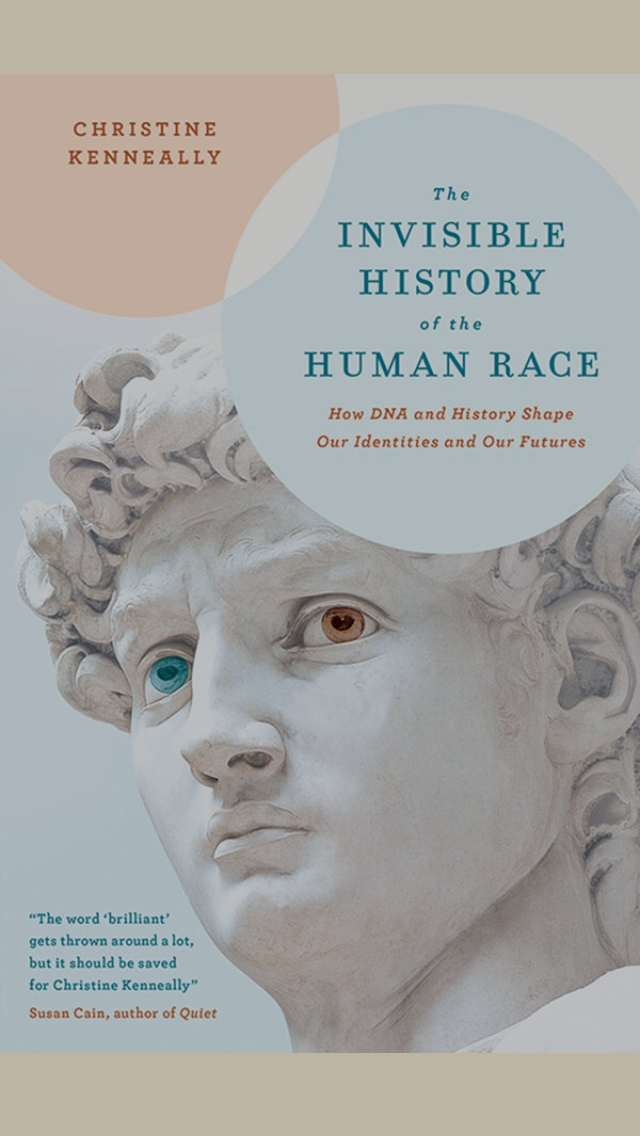
Book 16: The Invisible History of the Human Race: How DNA and History Shape Our Identities and Our Futures by Christine Kenneally.

This book was a Kindle sale item that came along just as a series on heritage and DNA was showing on SBS so I was the perfect target. It is a fascinating read that goes through the various aspects of our history as told through DNA, whether it be explaining how the very idea of genealogy developed over time, through to the dark era of eugenics, and then onto the modern era of genetic testing and genotype mapping.

I was hooked from the get go, with the book inspiring me to delve into Ancestry.com and build up my own family tree. Definitely worth a read if you are interested not only in your own family history, but the history of humans throughout the ages.
IMG_7563

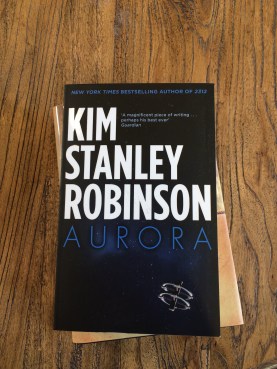
Book 17: Aurora by my favourite author Kim Stanley Robinson.

This book was a read from last year that I kind of read again by accident, or as much as one can read a book by accident I suppose. I had previously bought the book on my Kindle when it was released, but my awesome wife picked me up a physical copy as a surprise last month, which precipitated this year’s read.

Last year Aurora, it really took me by surprise. At the time I considered it quite pessimistic for a book by KSR, who I usually see as presenting very realistic approaches to modern day utopian thinking. So I think when I first read this book I was taken aback by what I perceived as a disparity between what I was expecting, and what I received.

Being able to tackle the book again however, I was able to separate my expectations, and really focus on the story; and I loved it.

Set on the tail end of a generation ship’s journey to a distant star Aurora is a hard science fiction tale that deals with the repercussions of isolating a group of humanity, and earth’s environment, in a closed system, and sending them out to fend for themselves for hundreds of years. I won’t go into it in any more detail, as the story takes some interesting twists and turns, but I highly recommend investing some time with this book, particularly if you like your sci-fi full of chunky ideas to sink your teeth into.
IMG_7564

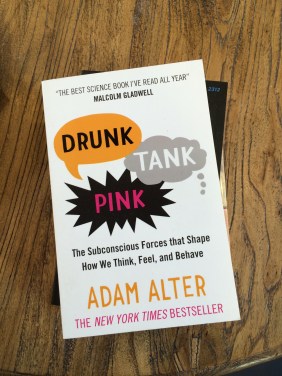
Book 18: Drunk Tank Pink

An impulse buy from the $5 book shop, this book reminded me of Freakonomics, but if it were written from a psychological/marketing perspective. A lot of interesting insights into human behaviour and how our minds work. The title itself refers to a particular shade of ink that appears to sap people of their strength (hence the use in drunk tanks), but delves into everything from how we interact with the environment, how other influence our actions, and how the tiny little things in life can often have grand and far reaching consequences.

The scientific rigour is a bit lacking in this book, but that seems to come with the territory when dealing with this form of popular science book. So while it may bring to bear many interesting concepts and questions, you will have to delve into the literature a bit yourself if you want to be more thoroughly convinced.


Book 19: Heartland of Manga: Tokyo and San Francisco

I have written about this read separately, and you can find that piece here.


Book 20: Young Hitler, a Kindle Single by Paul Ham

World War 2 always has such a strange, perverse attraction to me. I am fascinated by it, and love watching movies or TV shows set during this dark part of our recent history, but it seems strange to voice this opinion without sounding, well, terrible.

Recently my own son summed up this ambiguity when he said to me “Dad, I know it sounds strange, but World War 2 is my favourite war.” It does sound strange, but I totally get it.

There is something fascinating about that era; about the world at war, fighting on a scale never before seen, with advances in technology that boggled the mind, and at the centre of it all a struggle of ideas and ideals.

And of course at the centre of much of this are the great individuals that helped shape the stream of history: the Churchill’s, Roosevelt’s and Stalin’s. But perhaps the longest shadow cast on this era is that cast by Adolf Hitler.

I am often put off reading books about the World Wars because of the sheer scale involved, and thus the commitment required to try and wrap one’s head around this significant part of our recent history. So when I noticed a book by Paul Ham on the Kindle Singles list, I was excited. Kindle Singles are small self-contained reads, and Paul Ham is best known for his works on twentieth century wars, so I figured this might be a good place to start.

And it was.

Young Hitler has a very well define scope; it wants to talk about Hitler’s youth, and how this shaped him into the man he would become. One thing that has stuck with me is how the author goes to great effort to show that Hitler was a human, not in an attempt to humanise him, but rather as a means of illustrating that the existence someone like Hitler wasn’t some evil being devoid of humanity; he was an evil human being.

This quote I think says it all:

“On the other hand, it is lazy to brand Hitler a monster, a psychotic killer, the incarnation of evil and then walk away as if our job is done, as it suggests that he was a rare and inexplicable phenomenon, a freak of history whom we’re unlikely to meet again, rather than a man with banal, commonplace ideas who reflected the darkest prejudices of European society.”

We have to strive to understand things like Hitler, because if we paint history with too wide a brush we risk letting the important little truths slip between the brushstrokes.
IMG_7565

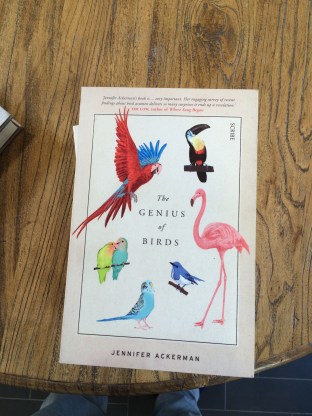
Book 21: The Genius of Birds by Jennifer Ackerman

A very eye-opening book about the heretofore unappreciated intelligence of birds. I love a good science read, and I love learning about the natural world; combine these with a gifted writer, and this has become one of my favourite books of the year. Sometimes I read a book, and enjoy it, but it fails to have that little extra that sticks with you; that changes your view on something, or enlightens you about something else.

This book was not one of those books. The Genius of Birds is one of those reads that helped create a new facet of my mind. I am now an ardent proponent of bird intelligence. I look at birds differently, I look at my dog differently; I even look at myself differently. So many of the anecdotes will stay with me, whether it be the Drongo mimicking a bird’s alarm call to frighten it away and steal its food, or the fact that pigeons can be trained to differentiate between impressionist paintings, and cubist paintings. I highly recommend this book to anyone who is interested in birds, in the various theories of intelligence, or who just likes a fascinating read about the world around them.

IMG_7566

Book 22: A Knight of the Seven Kingdoms by George R. R. Martin

Withdrawals from Game of Thrones led me to this read. A collection of short stories set 100 years before the TV show all following a knight and his squire. Not quite on the same scope as GoT, nor even the same tone, but an engaging read nonetheless. It was interesting to see stories set in Westeros, but from a more quotidian point of view.

Failed to slake my hunger however, so back to the forums and YouTube compilations of Jon Snow’s awesomeness for me.

IMG_7562

Book 23: The Happiest Refugee by Anh Do

The note on this book is from my 30th, almost two years ago… So I was happy to finally be able to check this book off my list.

It was a thoroughly great read. Anh is a very funny dude, and a great writer. The book really bring across just how down to earth and humble he is, but also shows how introspective he can be. Reading about his life, and particularly about how his childhood, and his parents, influenced the man he became, really spoke to me.

“There are only two times”, his dad used to say “theres now, and theres too late”. This seemed like a great motivational tool and indeed Anh presents it that way at first. But it also ended up being born from a pivotal (and tragic) moment in his fathers life. This book really highlighted for me the strange way that life takes us on a journey, without us ever really knowing it at the time. Much like how Kierkegaard said “Life can only be understood backwards; but it must be lived forwards”.

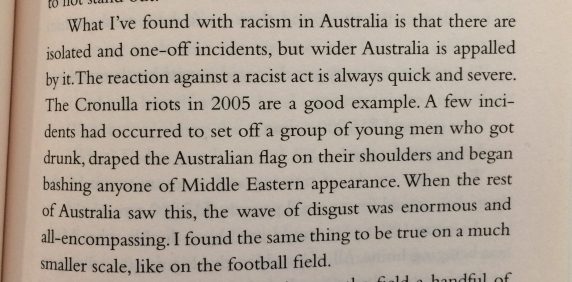
Given the state of things in Australia (the election of Pauline Hanson for starters), it is great to read this story of a refugee family coming to Australia, and making their life here. Anh’s story starts with his family escaping from Vietnam in a boat, something that should still resonate with Australians these days, but instead we find a growing apathy toward the plight of refugees from politicians from both major parties.
IMG_7568

Anh goes into racism a few times in the book, but mostly has positive things to say about his families treatment from the Australian public. I worry that the same story won’t be replicated by those refugees finding their way to our shores presently.


Now to get back into the swing of things, and start knocking over some more tasty reads.

#2016inBooks #accidentalrereadsarethebestrereads #needtoreadmore #GeniusofBirds #TheHappiestRefugee
 

Pokemon Go, Father-son time, and B. F. Skinner

Seems everyone is posting about Pokémon Go at the moment, whether it be to bemoan its existence, or to celebrate it. So figured I would weigh in with the little experience I had with my son this morning.

I love Pokémon. I was 6 when it came out, so I am the perfect demographic to have grown up with the Gameboy game, the TV show, Nintendo 64 offerings, and now during the mobile era the advent of Pokémon Go.

But for me the best part of Pokémon Go is the opportunity to engage and interact with my son in an exciting new phenomenon. I love being able to experience the world though Harrison’s eyes, I think sometimes we old people get a bit jaded, or perhaps just immune to the fact that we are living in an awesome future. Spend some time with a kid however and you get to see things from a fresh perspective. We have augmented reality games, rockets that land on barges, feathered dinosaurs, electric supercars; the present is rad!

So today we made sure to leave home ten minutes early to ensure that our walk to school and work would include sufficient Pokémon catching time.

We had a good run, visited a few Pokestops, and captured the odd low-level Pokémon. The most interesting outcome from this father-son gaming experience however was the opportunity to pass on a bit of my fatherly wisdom in the form of some psychology related trivia.

Education is such an important part of life, you should always keep learning things, and I love being able to share the knowledge I have of the world with Harrison. Watching kids grow up you never know what they will actually take from the information you give them, and what will be forgotten. But I think every little bit helps, and slowly the concepts and ideas will crystallise in their minds. So this is why our attempts to catch virtual pocket monsters was able to include a brief discussion about a famous psychologist and his pigeons.

I noticed that as we were walking along Harry kept waving his hand past the iPod’s camera, and checking his notifications. I asked him why he was doing this and it turns out that his iPod was struggling to get a GPS signal, but he had noticed the signal return when he had happened to move his hand past the camera. Being the science nerd that I am, I then proceeded to explain to him the story of B.F. Skinner and his superstitious pigeons.

For those interested, B. F. Skinner was a psychologist who liked to experiment on pigeons in the hope that his findings could be used to extrapolate theories on human behaviour. One of his more famous experiments involved setting up pigeons in a cage with a food delivery system that would reward them with food pellets at random intervals. Pigeons can be taught to peck at a lever in order to receive food, but the aim here was to see how they would cope without any clear way to get their food.

So the pigeons would go about doing whatever it is pigeons do while they wait for food, and every so often a pellet would randomly appear. After a while the pigeons began to behave as if there was a causal relationship between whatever they were doing at the time (whether it be spinning in a circle, or looking over their shoulder), and the arrival of their food.

With this causal link supposedly discovered, the animals would then perform the same actions in the hope of receiving more food in the future.

Not really the worst conclusion to draw, but not the most rational either. Skinner labelled these behaviours as superstitious, and hypothesised that similar effects can be seen in humans. And here Harrison was, proving my point.

It’s great because the concept of the experiment is simple enough for a kid to understand, and extrapolate from. Harrison said “What if it was jumping!” and then imitated a pigeon frantically jumping over and over in the hope of a meal; so he clearly got the idea.

We spent the rest of the morning sporadically walking to school, with the occasional stop in our quest to Catch ‘em all, but for me the morning was a success because I had been able to spend some quality time with my son, contribute to his education, and add a few steps to my day.

So while there may be a horde of people out there complaining about people spending too much time focusing on the virtual, or not engaging in the real world, perhaps they should take note of the fact that the world is changing. There is more than one way to interact with it now, and with others; we have all this amazing technology providing us with opportunities to do things we never dreamed of before, and to look at it with a closed mind means you will miss out on all these possibilities.

But hey; maybe I am just trying to justify the fact that it feels great to actually catch a Pokémon in the wild.

Cheers,

MM

Interesting related fact: B. F. Skinner attempted to create a pigeon-controlled guided bomb. https://en.wikipedia.org/wiki/Project_Pigeon


Lunchbreak rant: The Problem with Asserting Implicit Messages in the Bible

Ok, so this started as a response to a post on Facebook from one of my Christian Facebook friends (Hi Troy!) during my lunch break. But it slowly spiralled out of control, so I figured I would paste it into a post here, in order to get it off my chest.

The article in question is linked below, and seeks to explain why the exhortations to stone people in the Bible don’t need to be taken literally today.

First of all, the author points out that many of the passages in question apply only to the Tribes of Israel, and cannot necessarily be extrapolated further than that group of people. I have to ask; if the laws in that part of the Bible are a covenant between the tribes of Israel and God, and thus not something that modern Christians have to follow, then how is this not some form of moral relativity?

This however is only a minor point in the article which focusses the rest of its argument to the idea that ancient legal practices were different to today’s, and that we must look at the words of the Bible through these Bronze Age lenses.

The article suggests that the laws written in the Bible are not meant to be taken seriously, as often punishments in the area weren’t handed out. I thought this was meant to be the word of the god, and thus a trustworthy document? Comparing the apparent rules of a creator with the pragmatic governments of the time seems to be troublesome.

The article notes the “the absurdity and impossibility of putting many of these laws into practice.”, yet still wants us to trust in the general idea behind the law. But why not apply this logic to other parts of the bible? It is perhaps absurd and impossible to expect gay people to not be gay, and yet this is what many Christians today claim.

If these “were not meant to be complied with literally even when they were first drawn up, [but rather they] serve an admonitory function”, then why not simply state this in the document that outlines the laws?

The text literally demanded a person be put to death but assumed the punishment would be substituted for a fine set by the courts.” Strange to think that these pretty explicit laws can be assumed to be paid off with a bit of cash. How can a legal system be considered fair when it can be so skewed by the wealthy?

The article likes to say that the way that these systems were meant to be employed was implicit in the document. I have heard the same argument employed by some homosexual Christians to explain how the Bible doesn’t decry same-sex relationships, but rather only certain kinds of same-sex actions. They say that it is implicit that when the Bible says “a man should not lie with a man as a man lies with a woman”, that it really means in a sinful manner, as can be done with heterosexual couples also.

The problem with trying to insert implicit things into the interpretation of the Bible is twofold: first it assumes that we can infer these implicit things by looking at other documents, when the Bible claims to be a wholly singular read. And secondly it then has to explain why such an important thing (the very word of a god!) would have relied upon implicit messages, when explicit ones would serve better. After all you don’t see lawmakers these days using implicit language in important legal documents.

I especially like this passage:

Old Testament scholar Joe Sprinkle notes that “‘life for life,’ in the sense of capital punishment, has an explicit alternative of monetary substitution.”

Really? I expected more from the Bible when it came to the idea of the sanctity of a human life. Instead here we find the assertion that taking a life is simply a monetary transaction, and that if you have the means, you can buy your way out of any punishment or culpability.

So really, if the contention of this author’s article is to be taken seriously, that is, that when the Bible says that a personal shall be put to death the Bible doesn’t mean literally; then perhaps the Bible needs to be rewritten, so that it says “the murderer shall be put to death, or pay a ransom”. Would not that be simpler, and more timeless? After all if an omniscient god was the origin of these edicts, then surely it would note the inherent problem in relying on customs that don’t span the breadth of time.

“It is not at all clear that the Old Testament ever commands Christians to stone women who commit adultery.”

Actually, many of these commandments are pretty explicit. Sure you can argue that there are later passages that can be used to infer that this isn’t so, but that argument can be applied elsewhere also (with worrying effect). There are passages saying “Thou shalt not commit murder”. But then subsequent murders are sanctioned. So can we say that it is implicit that some murders are ok? The fact of the matter is, if we are to take the Bible as the word of a divine being, and the framework of a moral system of laws and commandments, then there shouldn’t be such problematic implicit readings. This in itself should cause us to question the legitimacy of such a divine document.

The genre of the passages, in light of the common ancient Near Eastern legal practices and customs, suggests(…)”, if ever there has been a time to acknowledge the human origins of the Bible, then surely it is after reading this sentence. If we have to look towards ancient, and many would say out-dated, forms of society and legal system to try and explain an apparently timeless and absolute moral system, then surely we can see that these laws are a product of their time, and not the divine.

Lunchbreak rant complete.

MM

Thoughts on Heartland of Manga: Tokyo and San Francisco by Craig Atkinson

IMG_7490 2

[Full Disclosure: I know the author of this book, he is a childhood friend of my sisters. And while I would argue that this hasn’t influenced my opinion of the book, it is definitly the reason why this book was made known to me.]

Heartland of Manga: Tokyo and San Francisco  is a small collection of pieces written by Craig Atkinson, an Aussie expat living in Japan.

This book is not the kind of read I usually fill my nights with. Indeed the best thing I can relate it to on my bookshelf is a book purchased years ago by Tim Winton. But sometimes it is great to slip out of your comfort zone, and really embrace something new and different.

I like being transported to different worlds. This is in part why I love reading science fiction so much; to imagine strange new worlds, concepts, or technologies, and see how they would play out in reality. But a good book can obviously be about more than just some currently unattained reality. As one of my friends once remarked to me online, “Books teach us about the years we didn’t/will never live“, and this book does exactly that.

It gives me an insight into parts of the world I have ever been, cultures I haven’t encountered, and viewpoints i had never glimpsed before. It made me look up what a Golden Week was, and wonder what exactly people were eating when they tucked into some yakisoba.

Some of the vignettes are probably first hand accounts, retellings of Craig’s experiences over the years, but others seem to be fictional sorties brought about due to his experiences out in the world. Two such stories tell the contrasting viewpoints of a simple silent encounter in the Japanese night. A small flicker in time between two people, whose inner thoughts are brought to life. I liked how the writing captures the little things in life that tell so much about ourselves, but that go unsaid:

The type of conversation that would last for hours if verbalized, but when it’s unspoken like this, it only lasts a few seconds.

One of my favourite chapters is simply titled Baseball, and describes a local match taking part in Japan. The narrator casually explains what he sees around him, whether it be a description of the current game, the season, or the people surrounding him; slowly a picture is painted of what it would be like to be there. But also you get little insights into life, like the following observation of a family that had attended the game:

The game seems to have brought the family a little closer together. That closeness was not something that could have been bought for the small price of a few tickets in the outfield, but with something money can’t buy: time.

So true. So obvious, and yet it was a thought that I hadn’t really taken he time (heh) to really absorb.

I am a big fan of saving quotes on my kindle, especially when they ring true for my past experiences, or offer some insight into life in general. In the following quotes I can see a reflection of myself at certain points in my life, and it is always bracing to see fiction hold a mirror up to your psyche, if only to have the opportunity to empathise, and reflect:

I think loneliness can sometimes be manageable when surrounded by familiarity.

If he had the courage to do what he wanted, to live unrestrained, how life might be different.

And lastly, in a self referential kind of way, this quote sums up my feelings about this little read:

(…)like a good book, that even when you reach the last page, you still search for a hidden chapter until you realize the story is complete and embedded in your soul.

I did want more, and I hope in the future I will find a few more reads coming my way.

MM

Spirit on the Spirit of Tasmania

Ok, so some people may know that my family and I were on the recent Spirit of Tasmania voyage that lost a man overboard.

I don’t want to sensationalise things, or try and make this a thing about myself, but after having this experience, I do want to say a couple of things on the subject.

One thing that I say to my son as often as I can when bad things happen is that I believe people are inherently good. It may be naive, but that is what I think. And I love the fact that this view gets vindicated so often; time and time again. Sure there are horrible examples of people doing terrible things, but these are the outliers, and I would argue that the bulk of humanity are good decent people.

So when the alarm sounded on-board last night, and people drifted drearily yet urgently toward the mass meeting at the rear of the Spirit of Tasmania, it would have been easy to imagine people being irritated, or annoyed at such an upset to their plans. But when people began to understand the nature of the situation, and that it was someone’s life possibly on the line it was amazing to see everyone come together in solidarity.

No one was complaining; no one appeared irritated. There was a solemn atmosphere as everyone’s thoughts were clearly with the man overboard, and the rescuers putting their lives at risk to help (one of whom was apparently injured).

People are inherently good.

What’s more, you hear a lot about people alleging our current selfie generation, and how people are all too keen to snap a photo, or click a button, rather than engage in something truly human. Yet when there were lights spotted out the windows, and people could see the rescue vehicles going about their job trying to provide essential assistance, there was no flurry of cameras, there were no extended arms trying awkwardly to get cameras far enough to include their owners faces in the frame. People were interested yes, people looked on, and passed on information to those around them. But it wasn’t selfish, it wasn’t for them; it was for others.

People are inherently good.

After nearly three hours sitting in our makeshift meeting area, when we would all have preferred to be sleeping in our undulating cabins, nary a complaint was heard. People were worried, people may have been scared, but they were nevertheless united in an understanding that no matter what inconvenience might have befallen us that night, it paled in comparison to whatever was taking place on the roiling seas below, and the impact it would have on other peoples lives.

People are inherently good.

In those seas below was yet another sign of people lending a hand. Two freighters joined the search, circling in a makeshift flotilla of hope. The second Spirit of Tasmania halted its journey back to Melbourne to lend a hand, and remained there until early this morning. The crew had earlier asked for help in spotting the man in need of rescue, scores of hands rose instantly in the air.

People are inherently good, and though this was undoubtedly a terrible event, a horrible night on the Bass Strait that appears to ultimately have ended with a life lost. It nevertheless reinforced in my mind the fact that us humans are deep down a decent bunch. We care about others we don’t know, we are willing to put aside ourselves when others are in need, and we do it all instinctively.

People are inherently good.

IMG_1096

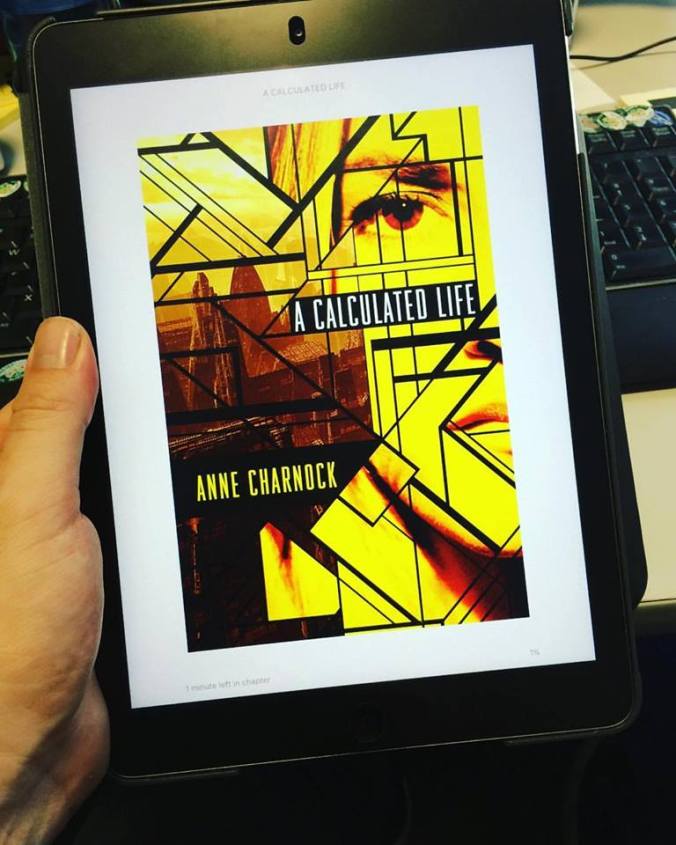
Book 15 for 2016: A Calculated Life

13174023_10154283634753755_7985387108270342728_n

I worry that Amazon’s predictive algorithms, and my tendency to end my nights with a read in bed (particularly nights after a beer or six), will slowly deprive me of all my savings.
This week’s read is A Calculated Life. What is it about? I don’t really know.
This isn’t one of those books that I have heard a lot about over the years like Old Man’s War. This isn’t an acclaimed book by an international author that has finally been translated into English like the Three Body Problem. This isn’t a book that I researched in order to enlighten my understanding of certain parts of my life, like the Compassionate Carnivore.
No. This is one of those books where my late night, beer-addled, brain clicked Buy Now, for reasons that baffle my current sober mind.
What is it about? I cant say beyond the simple blurb that Amazon targeted me with late that night. But hey, life isn’t just about doing what you plan to do, sometimes surprises come along the way. So I shall give it a go, and hope that Mathew after a few beers knows what Mathew before a few beers likes.
‪#‎2016inbooks‬ ‪#‎ifyoudrinkandbuyyoureabloodyidiot‬ ‪#‎MysteryBook‬‪#‎drunkMathewOwesMeALotOfMoneyYetICantBreakHisLegsToGetItBack‬

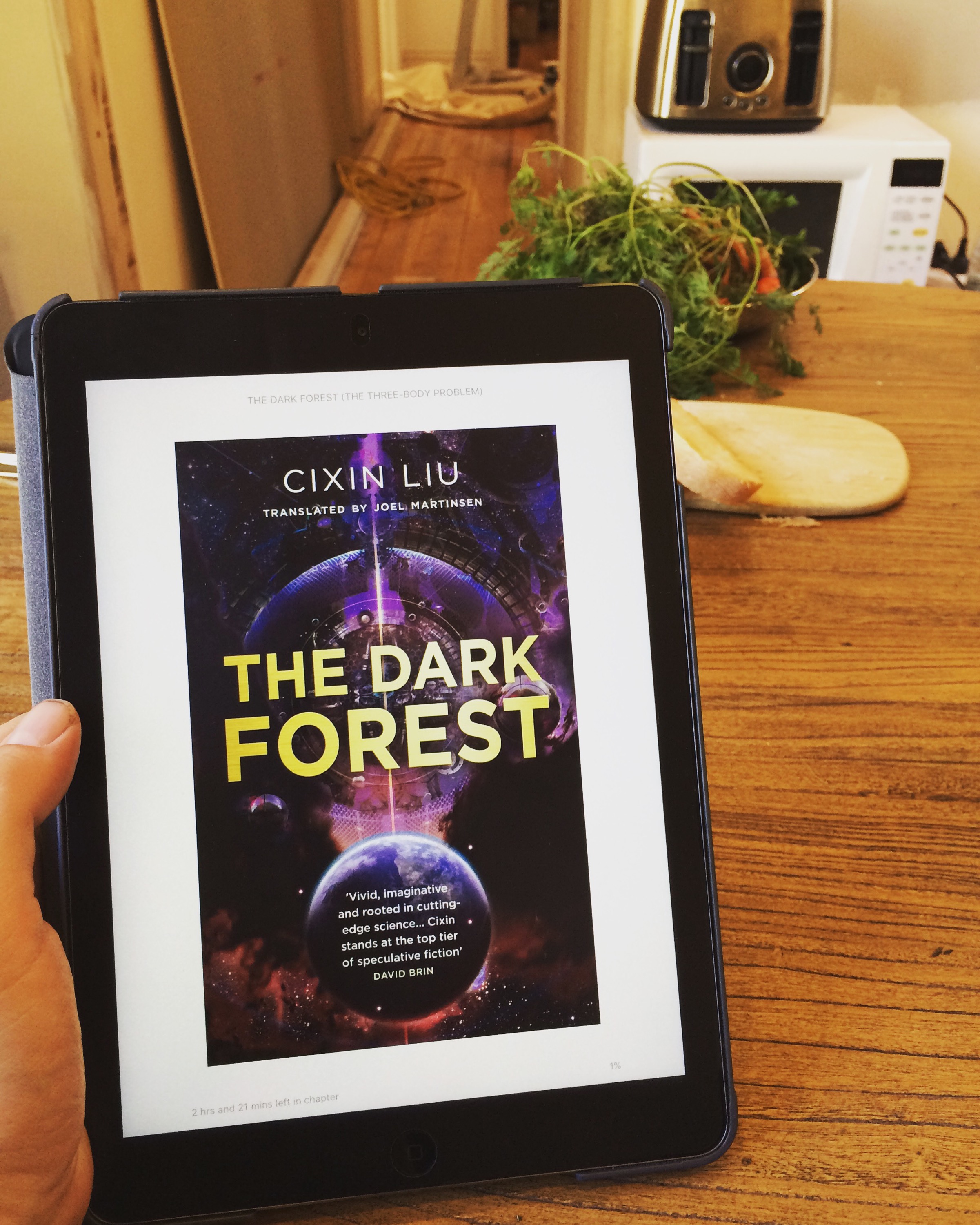
Book 14 for 2016: The Dark Forest

Busy times these past few weeks, what with my son’s eye surgery and
kitchen renovations underway, I have found myself knocked out of my
regular routines, and often out of my regular bed. This has meant
less chance for reading, but like all true book addicts know, you
can read anywhere. So while I haven’t been posting, rest assured I
have been reading.

And this is what I finished reading last week, the middle book in
Liu Cixin’ Remembrance of Earth’s Past trilogy: The Dark Forest.
Getting into Liu’s previous book I wasn’t even aware that this
constituted the start of a trilogy, but once I had made it to the
end I was thrilled to hear that here were two more installments on
the way (Now I just have to wait till September for the finale to
be released in English; damn my monoglottism!). This is one of those cool science fiction stories where they come
up with an initial premise that seems like a basic and simple to
begin with, but as the author slowly teases out all the
consequences that you hadn’t quite thought of, they end up building
a fascinating and complex world that really draws you
in.

Can’t wait to see how the trilogy pans out!
#2016inbooks
#AlwaysTimeToRead #ChineseSciFi
#SomeoneTeachMeMandarin

Thoughts on my Apple Watch

No Watch.JPG

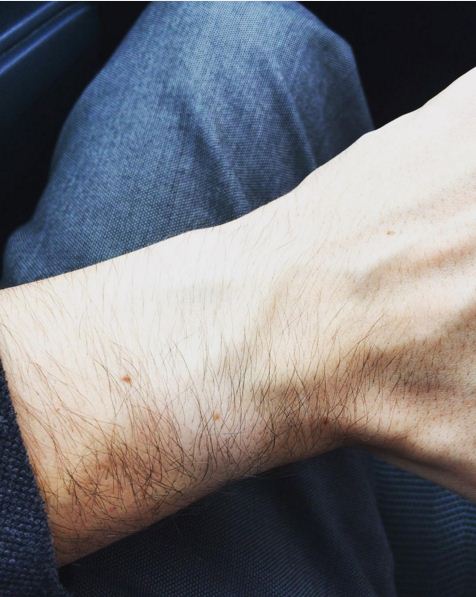
Look at this bland Apple Watch-less wrist. Look at the pale mark showing where it once was; this is what I have been looking at multiple times throughout the day. All because I left my watch at home, for the first time in almost a year. And I have to say, I feel it absence.

People often ask me if I think the Apple Watch was worth it, or what necessary function it performs. Usually I don’t put much thought into my response because, well, I didn’t make an informed decision about what this watch was for when I bought it. I just wanted it. I wanted the awesome gadget; I wanted to feel that feeling of having a bit of the future in my hands, like I did back in 2010 when I was an early adopter of the iPad (which people often questioned the usefulness of also).

So for me the Apple Watch didn’t really have to prove itself to me, I was just excited at getting it. At the novelty it provided. But now, being apart from it for the first time in a long time, I can actually start to evaluate its usefulness in my regular quotidian existence.

While I don’t think the Apple Watch represents as significant of a shift in the way we view digital information as the iPad did, I can definitely say, after this mere eight hours without it on my wrist, that it has a place in my life.

So much of how I deal with my phone, and the information I get, seems like a chore without my watch.

  • What’s the time? I guess I will have to pull out my phone.
  • What was that buzz in my pocket? Better unlock my phone and have a look.
  • How much money do I have for lunch? Please wait a moment while I dig into my pocket.
  • What’s the temperature? Siri can tell me, but I used to just have to turn my wrist.

Now yeah, I get it, it is a lazy thing. It is an indulgence, a first world luxury. So it makes getting my notifications easier, big deal; life isn’t about notifications.

But you know what, for some pretty important parts of my life, it is.

My wife and son are in Melbourne for a visit to the eye doctors after surgery last week, and so every beep and buzz of my phone leaves me feeling anxious that this is the news I have been waiting for. So far all day it hasn’t been, but I have had to check my phone each time just to see.

Plus what is life about really? I don’t think any of us can claim to know with any confidence

But one thing I know for certain about life is that it is finite. We only have so much time to experience the world we live in, so many hours to spend with the people we love. The philosopher Seneca spoke about the shortness of life; “It is not that we have so little time but that we lose so much”. My Apple Watch saves me time, and for me that is good enough.

#AppleWatch #FirstWorldProblems

Can you hear it, that slight whirr in the distance? That’s the future, and it’s coming today.

I am excited.

Today the world is introduced to the Tesla Model 3.

For those who I haven’t yet proselytised to, the Model 3 is Tesla Motors foray into the affordable electric car market. Previously Tesla has only made high-performance roadsters, luxury sedans, and a newly released luxury SUV; all running on their excellent electric powertrain. But Tesla’s long-term plan has always been to get in a position to create an affordable electric car for the masses. Indeed one of the things I love about Elon Musk (founder/CEO of Tesla Motors and SpaceX) is that he always has such grand plans for his businesses. It’s not just about making cars or going to space; it’s about the future of mankind. Just look at Tesla Motors official business goal:

To accelerate the advent of sustainable transport by bringing compelling mass market electric cars to market as soon as possible.

Note that it isn’t just about them making the best electric car (though they do), but rather about bringing about a future where everyone drives electric cars, because that’s what all the car companies make. And while some may doubt the seemingly altruistic (and possibly self-detrimental) goal of this ambitious company as mere spin, the fact that Tesla recently made their patents available for anyone to use should help sway any doubts.

I have been fully wrapped up in Musk-mania this past year, telling anyone who will listen to me about how not only is Elon Musk objectively the coolest guy alive right now, but how his companies Tesla and SpaceX are going to change the world. The unveiling of Telsa’s Model 3 has always been a game changing point when I have talked to people. Watch this space, I would say, because when it happens it could possibly change the way the world looks at cars.

Well now it is happening, and I am brimming with excitement.

And I’m not the only one, for a couple of days now people having been lining up at the Tesla stores in Melbourne and Sydney just for the chance to pre-order a car that not only probably won’t be available for another two years, but one that they haven’t even seen yet! Just look at one of the lines currently snaking its way from a store in America; people are excited.

View this post on Instagram

Longest line EVER! #Model3 #SantanaRow

A post shared by Tesla (@teslamotors) on

I can’t wait to see it come 2:30pm (8:30pm in the US). I want it to look cool. I want it to have amazing features. I want to be able to show people who aren’t aware of Tesla Motors yet, and watch their mindset change as they realise that not all affordable electric cars have to be little Leafs, or humpbacked Priuses. I want the car to scream; Here I am; I’m the freaking cool electric future here to save the day!

But hey, you don’t have to look far to find rabid Tesla fans on the internet, and clearly I am one of them. I am one of those tragics who has been following Tesla for years, despite their cars being well out of my price range. Multiple times I have gone to the Tesla website, customised my Model S, and stared longingly at the electric future that was just out of my grasp.

The best I have managed is to slowly buy myself some Tesla shares in the hope that one day, I can transform them into a portion of my very own kick arse electric car. But until then I will have to make do with my little Model S Hot Wheels, taking pride of place next to my alarmed Spiderman toy, and my Van Gough cow.

image_3

It is a zero emissions car

But the Model 3 is bringing this future tantalisingly close. I can actually see myself being able to buy one of these cars in the 6 or so years that have to pass before my family needs a new set of wheels, so for a future that seemingly assured I am willing to wait.

Also in some weird quirk of cosmic coincidence, the price of my tesla shares, converted into Australian dollars, just happens to equal exactly $300.000 at the moment:

tesla share price

Quite fitting for the debut of the Model 3

Tesla Model 3, trust me, this is going to be a changing point in the history of the motor vehicle.

Some Quick Thoughts on Batman Versus Superman

*Relatively spoiler free review, feel at ease and read away*

I went into this movie wanting it to be good, but expecting it to be bad. I knew that DC and Warner Bros. had a lot riding on this movie’s success launching a whole cinematic universe, so reservations about Man of Steel aside I decided to hope for the best.

I have to say I was pleasantly surprised.

People in the future will no doubt look back on this movie with different criteria, and different eyes, that I view it with tonight. But I think a lot of today’s media is looking at Batman Vs Superman and comparing it to one film; The Avengers.

And can we really blame them? A comic franchise bringing together their greatest heroes in one big smackdown; both films seem to offer the same thing. But look at the way these have been executed, and you can begin to see that these are very different films.

The Avengers was about bringing together our heroes to fight a bigger cause. It was pretty obviously good versus bad, with a bit of brainwashing thrown in for fun. But Batman Versus Superman is a different beast altogether. Its about how a being like Superman can be shoehorned into a modern world like ours, but also with Batman.

akimybqyiv6u7rop1xov

I’m here too

But as tacked on as that last bit appears to be, it really works.

BvS (its quicker for me to type that way, as I just finished watching, and it is 12:30 am on a long weekend, and i wants my sleep).

BvS rather than being a story that brings our heroes together, is a story that is driven by our heroes trying to exist in the world, and how difficult this is.

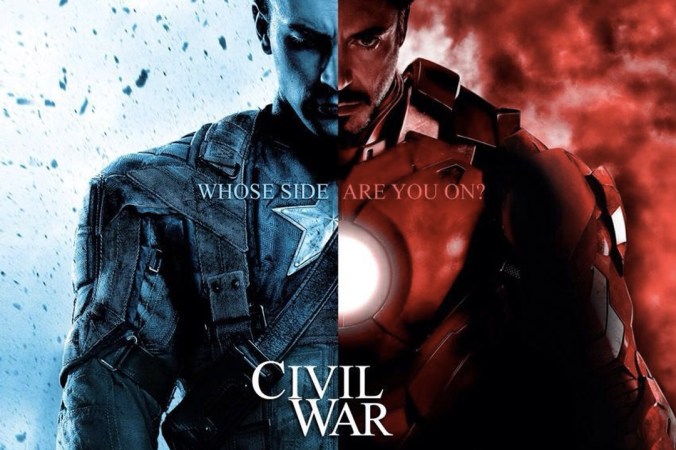
Batman has seen the danger Superman poses, even if at present he is apparently good. And Superman sees that as much as he wants to just do good in the world, people won’t accept his word that his actions are good. The government wants accountability, and so does Batman.

(Hmm, superheroes being held accountable, sounds familiar….)

civil-war

We also exist

But overall I have to say that while the Marvel Cinematic universe (and yes in my point of view the comic universes as well) is superior to these DC offerings, I can’t help but concede that the DC characters themselves are much more Iconic. Say what you will about the awesomeness of Iron Man now, pre 2007 I had to explain to people who he was. Nowadays everyone knows he is Robert Downey Jr with awesome toys.

DC however is a whole level above that, and rather that start with some slightly obscure characters and bring it together, they are bringing out the big guns all in the second universe building film.

So let’s have a quick run down based just on the characters.

Superman

_1406998169

Virtue is boring

The most integral part of the story, but as always for me, the most boring. Superman is such a morally pure being that he doesn’t even seem like a character, but rather the embodiment of an idea. So while it may be nice to have him in the story, it is never really that interesting to watch what he will do (long story short, he will do the ‘right’ thing).

Also, for the love of god in this day and age it makes zero sense that people would not be able to tell that Superman is Clark Kent; seriously. We all have smartphones, and the internet. Clark Kent truthers would be everywhere.

Batman

akimybqyiv6u7rop1xov

Misplaced childhood anger is cool?

Ok, let me assure people, and get it out of the way: Ben Affleck’s Batman kicks arse.

When you watch him throw someone’s head into the floor, or hurl someone into a wall, you know it is for real and he is leveling thirty odd years of mental turmoil at his foes.

Yes the Batman voice may seem a bit put on, but luckily even the awesome Christopher Nolan/Christian Bale films have shown us cool characters can have shitty voices.

I cant wait to see a standalone film, especially if it allow Alfred to do more than be a sidekick in a cave.

Wonder Woman.

bvs-wonderwoman-poster-frontpage

I kick more arse than you are expecting

I was prepared to not care much about Wonder Woman, and to save my impressions for her inevitable feature film, and it always looked like she was going to be a simple tack on during the movies main fight scene.

And this is pretty much true.

Yes she appears early on, and they try to build her character. And yes her inclusion ultimately leads into the bigger universe, and starts to build a cinematic universe more believably. But really her part in the story seemed cliche and unnecessary.

But then came that entrance.

I wasn’t expected to be blown away, and on retrospection it wasn’t anything lifechanging. But when she makes her proper entrance (in full costume), the scene is quite breathtaking. Guitar music strums unexpectantly causing adrenaline to flow, and suddenly we are faced with a kick arse amazonian woman.

And believe me, for her brief time on screen, she really kicks arse. In fact she kicks arse to such a point at times that you wonder why Supes and Bats don’t just step back and let her finish the job.

But that is for another film.

Lex Luthor

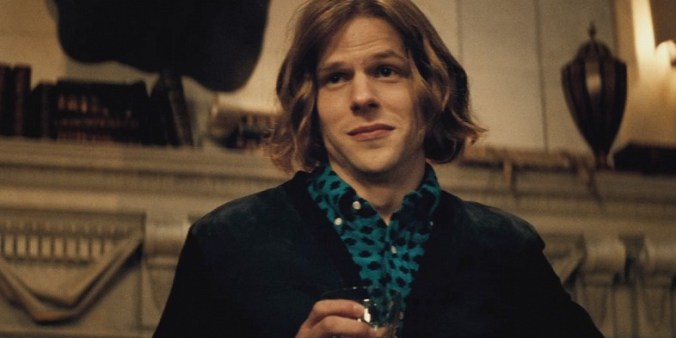
Lex-Luthor-Batman-V-Superman-Hair-Jesse-Eisenberg

You just know that hair cant last; it must be destroyed!

Much flack was copped when DC cast Jesse Eisenberg as supermans nemesis. And then when he first appeared in a trailer as an eccentric long-haired almost prancing villain, people became even more worried. But having been there back when people (myself foolishly included) bemoaned the fact that a certain Mr Heath Ledger was cast as the Joker, I am more that willing to accept that an actor can take a role and really surprise you.

But then again I knew Jesse would rock it, so it came as no surprise to me when i fully bought him as a character.

Lex is a tricky character to bring to the screen, because a regular human taking on a virtual god is such a hard hand to play. I have to say though, in this film, I think it works. There may be some confusion as to how it all ended, and what it all means from Lex’s point of view. But the way that Lex manages to play characters off each other, and maneuver himself to being able to control events and people as grand as Superman and Batman is actually truly impressive. It quite chilling to watch this mere mortal manages to impose his will on others.

Some guy

Also some guy played by Drazic from Heartbreak High is in it, so both the Marvel and DC universes can be ticked of actor Callan Muvey’s wishlist.ome

Seriously look him up, he is pretty awesome:

https://en.wikipedia.org/wiki/Callan_Mulvey

Conclusion:

This is a good film about Batman versus Superman. Don’t go in with wild expectations, dont want it to be more than it is. Watch the story, think about the characters, and enjoy the tale, because this movie definitely has a story it wants to tell.

Final verdict?

4/5

(Note, many beers at the cinema and staying up till 1:20a.m. might inflate my initial estimate, future opinions may deviate)