Quick thoughts on the latest Star Wars: The Force Awakens trailer

MF

Man; I am excited about this film. Even though this trailer give me no idea of what the storyline is going to be; it still somehow reassures me that this film is going to be true to the Star Wars world.
How can a Star Wars fan not be excited about this trailer, and thus about the upcoming film? The visuals, the music; the Han Bloody Solo!
Yes a lot of us remember the prequels being a bit of a let-down, and therefore are doing our best to not throw our hopes as high as they may have been in 1999. But I can’t help feel that here are a few legitimate reasons to be optimistic for the new trilogy.
First of all, I have faith in J.J. Abrams. Excessive lens flare aside, I think the man tells a great story, is able to make interesting characters (Jack Bristow FTW), and in general makes entertaining films. He is able to capture the essence of the stories he sets out to tell.
Second, we have enough from the old Star Wars trilogy to make it feel familiar. And I don’t just mean Ford, Fischer and Hamill; Lawrence Kasdan is back as co-writer. In case you don’t know, he was the co-writer of Empire Strikes Back, arguably the best of all Star Wars films.
Plus if The Force Awakens is a good film, then it means the majority of Star Wars films are good films, regardless of what you think of the prequels.
But having finally seen the trailer (as thin on actual plot details as it may be), I think I can see the way that Abrams will be taking this story; and I like it.

its true

All of it

What I take from this trailer is that The Force Awakens will be a story about the Star Wars story itself. A kind of meta self-referential tale about the power of the Star Wars story.
Star Wars casts a big shadow not only on science fiction films, but on film-making itself. It opened up a whole new way of telling stories, and inspired a new generation of directors. Directors like Abrams himself.
Abrams has long been a Star Wars fan; in fact I remember an interview with him upon the release of his reboot of Star Trek where he talked about not knowing much about Star Trek, and being more of a Star Wars fan.
In his film Super 8 Abrams gave us a movie that was as much about film-making itself as it was about an alien stuck on earth. Many claimed it was an homage to Spielbergian film-making (which I can see), but it was also a story about making films, and I think this is an example of how Abrams is able to convey a sense of awareness in his filmmaking. He understands where these films fit into the public’s perception of them.
So naturally when tackling one of the biggest film franchises of all time, he knows that there is a lot of history surrounding this, and that the fans of these movies are a part of that. The story of Star Wars has been around for almost forty years after all, so it has had plenty of time to have a life all of its own, and to pervade the way we think and feel about other stories.
This brings me to, in my opinion, the most interesting part of the trailer  (narrowly edging out the lack of Luke); this exchange of words:

Rey: There are stories about what happened.
Han Solo: It’s true. All of it. The Dark Side. A Jedi. They’re real.

You can hear in her voice, in the way Rey talks about these stories, that there is a power in such tales. It is this talk of stories that to me explains the direction this movie may take.
The Star Wars world in these new movies is almost a parallel of our own. Indeed the passage of time between the original trilogy, and this new series has taken place in real-time, so the memories of what happened in those movies is comparable to the memories of those movies for us here in the real world.
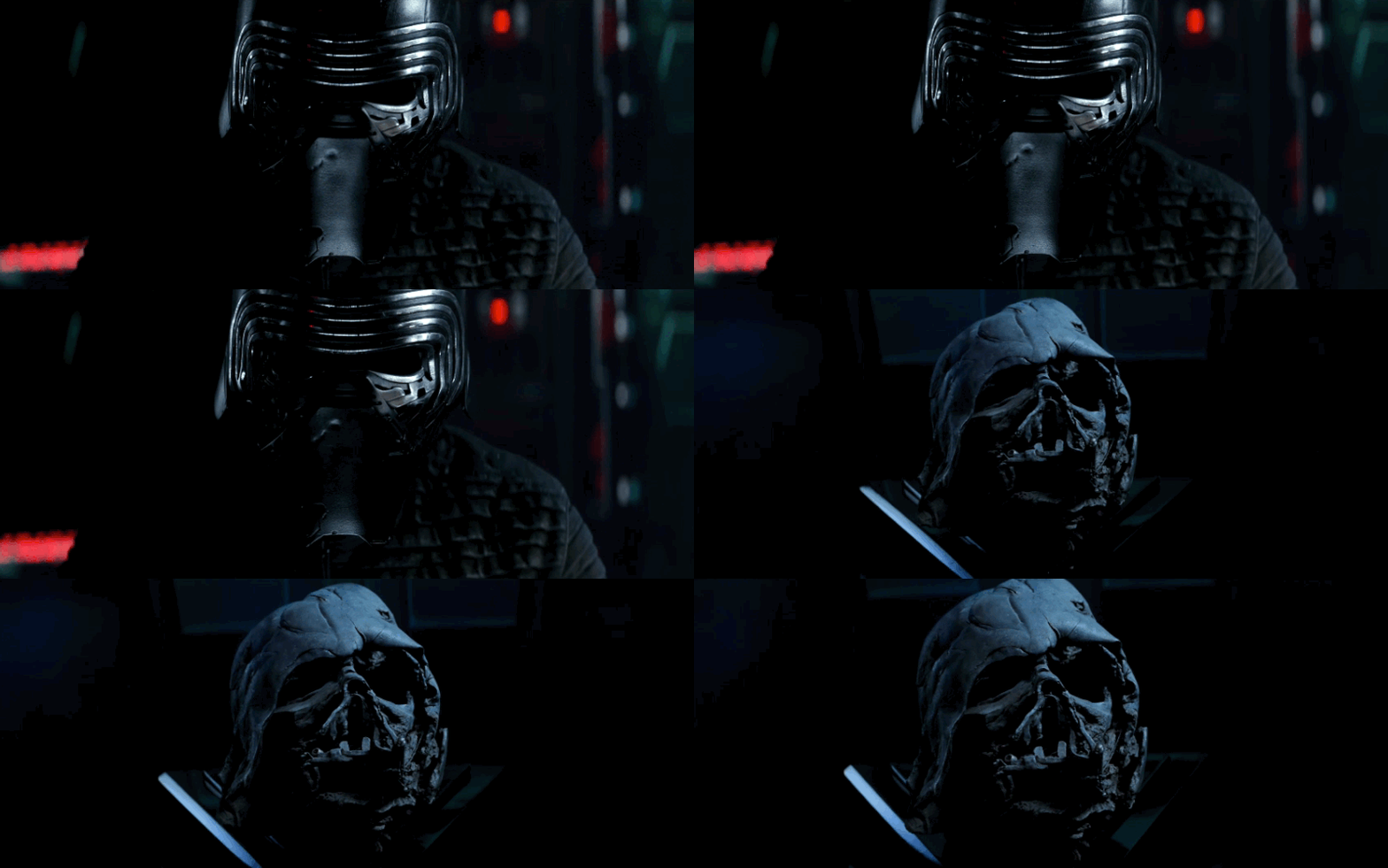
The power of the stories people told of the downfall of the Empire mirrors the power of the original Star Wars trilogy for us, the audience. The story of old glories come back, of the power of past experiences, rings true regardless of whether you are a character reacting to them, or an audience member reliving them. Even the films new villain, Kylo Ren, appears to mirror the public’s obsession with the classic villain Darth Vader, as he seeks to ‘finish what [he] started’.
vader fan
So perhaps this Star Wars will be a story about the story of Star Wars; about the power it has over people down the generations. It will be a tribute to Star Wars, as it very well should be.

Quick breakdown of other thoughts from the trailer;

  • Number one; where is Luke! Clearly there is a reason Luke isn’t being shown (beyond a pat on R2-D2’s head. Maybe how he looks will give something away (has he turned to the dark side?). Or maybe he simply isn’t that main of a character. After all he is also absent from the poster.

Rey explore

  • Rey’s travels through the ruins of derelict Empire starships just looks awesome. (P.s. when she is watching that ship fly off into the distance, there is clearly an AT-AT foot at the bottom of the frame, which is suggested to be where Rey lives)
  • The music in this trailer is awesome. Going to be great to hear John Williams on the big screen again.

battle

  • I like that we see Finn wielding the Skywalker lightsabre, yet I can’t help but worry that he is going to have his arse thoroughly handed to him by what appears to be a more sabre competent Kylo Ren. Unless there is going to be some awesome Jedi training montage in this film (seems unlikely), then this looks to be quite the mismatch. So either someone will come along and save Finn, or perhaps Kylo is more interested in collecting another Darth Vader icon than he is in disposing of Finn.
  • Speaking of Finn and Rey; what are their last names!! I can’t help but feel that at least one of them is being kept under wraps due to it being excitingly familiar (and familial).
  • Not much captain Phasma in this trailer.

air battle

  • Lots of awesome looking battle sequences though.
  • Lens flare.

kylo

  • Kylo Ren and his band of masked bad guys in the rain. And I don’t care what people say of its practicality; that red cross-guard lightsabre is awesome.

Finn down

  • Voiceover from Finn seems to lend credence ot the theory that he is a storm trooper who becomes disillusioned with the First Order after taking part in, or witnessing a massacre. Sure looks like he escapes in a TIE fighter and is shot down by a Star Destroyer over the junkyard planet of Jakka (soon to meet Rey no doubt).

MF2

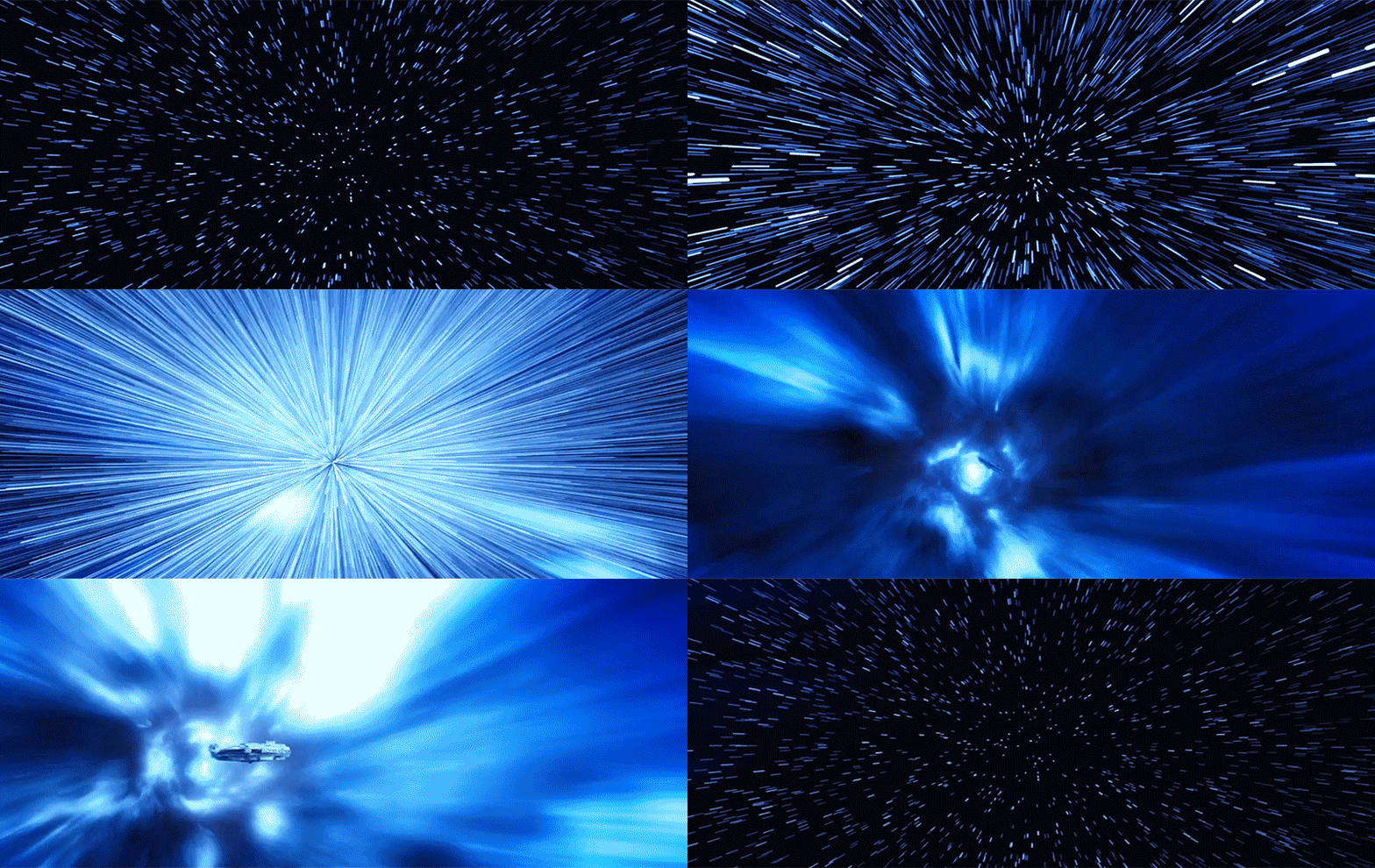
  • Millennium Falcon. Millennium Falcon! MILLENNIUM FALCON!!!!
  • People a long time ago, in a galaxy far far away, clearly have terrible memories. They don’t know about the Jedi, or the dark side? Much like these people seemed to have quite quickly forgotten about the Jedi and the power of the force in the original trilogy. Han Solo may just have no interest in history when he says “I’ve seen a lot of strange stuff, but I’ve never seen anything to make me believe there’s one all-powerful Force controlling everything.”, and perhaps when Motti references the Force as an ‘ancient religion’ he just forgot about the whole Jedi Council that existed a couple of decades previous. But it still seems odd that a civilisations collective memory could be so forgetful; its like people being shocked to learn that Nazis were real things, or that there used to be this thing called communism.

Some of My Investing Wisdom for This Tumultuous Time

/*Disclaimer – I am in no way offering the below as actual financial advice. If you are devoid of a sense of humour, or lack the gene required for detecting sarcasm; please dismiss the following post as the ranting of a unstimulated mind.*/

There has been a lot of talk of share market crashes and billions of dollars in value wiped from investor’s pockets of late, so if you are a potential investor or already have your own portfolio, you might be a bit distraught over what is going on.

For those of you worried about the share market I am here to tell you it’s time to relax! I am a market veteran (been buying shares for what must be months now), so here are a couple of tips and expert advice in handling investor anxiety.

Tip No. 1: Invest in crazy shit like salmon farms and electric cars.

If you do so, your shares will go all over the place all of the time, so when the market crashes it doesn’t affect you, because you are already used to sudden and devastating losses in your portfolio. I recently invested in a salmon farm and a company that does aerial photography. The share prices almost immediately went down (market analysts out there take note; your best indicator of a share about to plunge is simply whether or not I buy it). Down, then slightly up, but always down a bit more the next day; like a poorly flung yoyo. I can’t even remember what initial price I got half my shares at because their current values are so disparate from their originals that any sense of loss I have is numbed to a pleasant tingling sensation in my wallet.

But perhaps you are someone who is a bit more attuned to their personal wealth; maybe you like numbers, and such a slide in your personal wealth will be noticed, and slowly niggle away at your mind. Fear not; I have more investing techniques up my sleeve:

Tip No. 2: Buy international shares.

International shares help muddy up the waters when you want to understand (or be ignorant of) just how much money you have lost. They do this through the magical financial multiplier known as an ‘exchange rate’. Exchange rates tell you how much of some other form of money, your current form of money used to be worth, before it inexplicably declined in value. Thus if you buy international shares, the exchange rates distort the numbers; sanding away the rough edges of a market slump so that you are left with a roughly hewn “I guess I haven’t lost that much” attitude.

I bought Tesla Motors stock eager to be a part of the coming Electric Car Golden Age™, safe in the knowledge that Elon Musk would launch us into the future like one of his SpaceX rockets. Perhaps I should have taken into account that SpaceX’s rockets are striving to be reusable, so while they may soar to impressive heights (Tesla stocks had an all-time high of $291!), they also like to frequently return to their earthly lows (as of this moment, they are sitting at what I hope is a launch pad level of $220).

But the beauty of all this is that though my shares have in a sense lost value, that value isn’t something I can easily picture in my mind; it’s not like when my Nearmap shares went down $50, and I could taste the loss as a bottle of scotch I never got the chance to buy. Because my stocks are from the United States, I first have to try and remember what Australian dollars I spent on them, then how that converted into US dollars at the time, then how much the strength of our currency has changed since, and thus what these American dollar stocks would be worth if I sold them and recouped my losses in Australian dollars at the current exchange rate. I am sufficiently confused just writing it down!

They say you have only lost money on the share market if you get scared and sell your shares at lower than you bought them. Thus the foggy nature of international shares helps you to not even understand what your balance sheet looks like, which reinforces the deeply engrained aversion to action hidden away in our ape brains by evolutions invisible hand*. This in turn stops us from being a slave to the impulse to sell brought on by doomsday headlines and sensational talk about ‘financial crises’.

For those of you still sceptical, I will finish this post by leaving you with one last reason to buy international shares; because in America they are called stocks. Not only does that sound cooler^, but what you wily investors will now have is two portfolios; a stock portfolio, and a share portfolio. That’s not just diversification of companies, or industry types; that’s diversification on a thesaurus level.

MM

P.s. The above post is quite tongue-in-cheek (whatever that means), and I am actually quite happy with my share picks this year (just not at this particular point in time).

*Note: Not Adam Smith’s invisible hand; that’s another story.

^ You can check the comparative coolness of words here: https://books.google.com/ngrams/graph?content=stockmarket%2Csharemarket&year_start=1800&year_end=2000&corpus=15&smoothing=3&share=&direct_url=t1%3B%2Cstockmarket%3B%2Cc0%3B.t1%3B%2Csharemarket%3B%2Cc0

Why is Active Camouflage Less Prevalent in Terrestrial Animals?

Just one of the random questions I come up with throughout my daily life. Figured i would put it up here, and on Quora, and see if i could enlighten myself, and perhaps others.

I was watching an episode of Deadly 60 with my family when it highlighted yet another underwater animal that could actively change the colour of its skin to fit into its environment. I have always been a big fan of Cuttlefish for their colour and texture changing abilities, and was only recently (5-years-ish) made aware of how well octopuses can accomplish the same feat. But when it come to terrestrial animals, there doesn’t appear to be as many examples. There are Chameleons, Anoles, some frogs and thats really it, at least as far as a quick Wikipedia search can tell me.

Whats more, land based colour changers don’t appear to have the same standard as their waterborne kin. Cuttlefish can change their colours seemingly instantly, they use the pulsating colours across their skin to communicate, and can contort their bodies and the texture of their skin to complete their illusions of camouflage.

When camouflage fails; dazzle time

When camouflage fails; dazzle!

So I was wondering; why is this? Is there any biological benefit for a watery environment when dealing with active camouflage, or is are there differing evolutionary pressures that make it harder to adapt on land? Perhaps the mechanisms used to change the pigment cells in water based cephalopods doesn’t work well in the dryness of the land, or maybe the ocean bed is simply better suited for mimicry than the world above.

I don’t know; but I would be delighted if someone could enlighten me.

Cheers

P.s. One more awesome GIF for the road:

When people start talking AFL at work, I wish I could do this...

When people start talking AFL at work, I wish I could do this…

Parental Guidance Recommended –Reflections on determining what’s suitable for my son

I went to the movies recently to see Marvels latest outing; Ant Man. I was thoroughly impressed with the film, but as I was watching it I noticed that a new thought process was taking place in the back of my mind. Not only was I suspending disbelief, and trying to keep track of plot lines, or character arcs (or as this was a Marvel film; keeping an eye out for Stan Lee); but I was also evaluating the films suitability for my son.

It was strange, as this wasn’t as intentional as it had been when my wife and I had gone to see Jurassic World recently. Being true to the 50% of his genome that I contributed toward, my son is a massive dinosaur nut, so when the latest addition to the Jurassic Park franchise was announced, he was naturally interested to go. I wasn’t so sure however, as though he is 9 years old now, he can still be sensitive to the content of movies.

So  knowing this, when recently he wanted to watch the original Spielberg Jurassic films I was sure to watch them along with him, and made sure he was aware of any possibly disturbing upcoming scenes. Yes we may be sheltering him a bit, but it seems preferential to be involved in his viewings of such things, rather than let them go into the wilderness alone and possibly see something potentially disturbing (as I did when an aunty hired Watership Down for me, thinking it was a kids film, and left me unattended to bear witness to the horrors within).

Indeed a lot of my thoughts on this stem from my own childhood. When I was a lad and attended the premier showing of Jurassic Park at the cinema, I was unduly terrified of what I might see, as I had read the book beforehand to prepare me. The thought of seeing Nedry’s intestines spilled into his hands, or Henry Wu’s ripped out of his body, kept my hands firmly placed over my eyes for all of the famous death scenes. No surprise then that years later when I rewatched it I was surprised at how tame the scenes were, and how much worse I had imagined them. But I still wanted to make sure that my son was properly prepared for what he was going to see. It is after all a PG movie, and I am the P, so might as well do the G.

So for instance when Nedry was going to be killed, I let him know; when a lawyer was going to have a bad time on the toilet, he was fully informed. He handled it all well enough; was amused at the demise of Genaro as so many are, and generally wasn’t fazed by the experienced (in a negative sense anyhow; he loved the film. Next stop: The Lost World.

Again I was cautious, because though you don’t see that much direct carnage in Jurassic Park, the fate of Eddie Carr in The Lost World seems far more graphic. Again I prepared my son, told him what would happen and so forth, he was willing and excited to see it, and after the Rexs had had their meal, he was relieved and all was well. So I figured, hey that’s good; worst part of the movie over.

I was wrong.

I gave cursory warnings for what was going to come. Raptors killing people in a field; all good. T-Rex chomping a guy through the waterfall; he can handle it. However I was a bit surprised when the lead up to Dieter’s death was interrupted by a distraught look on my sons face (my wife on the other hand was more on the ball). At first I thought he was reacting to the frightening visuals of a man being swarmed by a flock of tiny dinos, but it turns out he didn’t like the bit where Dieter grabbed one of the compys by the neck and appeared to be strangling it!

We had a similar start many years before when a strangulation scene in Journey To the Centre of the Earth affected Harry more than anything else had (he had even been fine with Donovan disintegrating into dust in The Last Crusade, and the Nazis heads exploding and such in Raiders of the Lost Arc). So after this movie experience was over, we started to get a better idea of the things that bothered him (the repeated stomping of Carter was likewise not well received).

Women getting strangled, animals getting hurt, and protracted death scenes seemed to be the main causes of concern.

So armed with this knowledge, and aware of his excitement at the release of Jurassic World, my wife and I decided to evaluate its suitability for him when we went to see it.

*Spoiler Alert*

It didn’t take us long to come to a conclusion; this was not for Harry!

Women getting strangled/protracted death scene; the demise of Gray and Zach’s minder seemed very excessive, and not the best thing for a young kid to enjoy (you are almost relieved when she is put out of her misery!). But more to the point; the heartbreaking scene of the Apatosaurus death was definitely something we didn’t want our son to get upset about.

He is a caring boy, and he gets emotional as a result; it is a quality that I admire in my son, though it can be hard to deal with some times (like for instance when he questioned the right that my wife and I had to kill a plant that was entangling our fence, and grieved its loss).

Harrison was not very pleased when we informed him that Jurassic World was not a movie he would be seeing at the cinema, but he has accepted our reasoning, and we are glad that he is able to understand the motivation behind it. Furthermore my wife found a junior novelisation of the film for him to read, and he tore through it with vigour.

In previous times when we had warned him at the graphic nature of some movies and shows he would seek to allay our fears us by saying stuff like ‘Nah I’m fine with that. I have watched a bunch of murder shows with Pops; it doesn’t bother me’.

First of all, by ‘murder shows’, he means stuff like Foyle’s War and Poirot. Secondly we explained to him that we don’t want him to be ok with stuff like murder, rather we want him to be able to process it appropriately. Again he generally understands our views with stuff like this and begrudgingly accepts our parental censorship.

Now then, before this post gets too out of hand; back to the initiator of this post: Ant Man.

Sitting in the cinema, I became aware of how much I was evaluating scenes in terms of whether it was suitable for Harrison. It wasn’t at the front of my mind; I wasn’t doing it on purpose, or spending the majority of my focus on it. But I did notice that after a scene had taken place, be it a fight, or a death, or a adultish joke; I would think to myself ‘Yeah I think that’s ok for Harrison’.

It is interesting to note how little mental processes like this begin to form when you become a parent.

For example, I like to swear a bit in my casual voice. I don’t think I am an overly explicit person, but I like the emphasis afforded to English’s most versatile word, and if someone like Stephen Fry can extol the virtues of using the odd swear word now and then, I think I am in good company.

“Swearing is a really important part of one’s life. It would be impossible to imagine going through life without swearing and without enjoying swearing… There used to be mad, silly, prissy people who used to say swearing was a sign of a poor vocabulary -such utter nonsense. The people I know who swear the most tend to have the widest vocabularies and the kind of person who says swearing is a sign of a poor vocabulary usually have a pretty poor vocabulary themselves… The sort of twee person who thinks swearing is in any way a sign of a lack of education or a lack of verbal interest or -is just a fucking lunatic” – Stephen Fry on the joys of swearing

Nevertheless once my son got to an age where he would comprehend, and repeat words; it was clearly something that had to change. However I wouldn’t say that this change was an overly conscious decision; rather it just took place, and I noticed it at a later date. Suddenly I was like ‘Shit; you know what? I don’t swear that much at home anymore.’ Perhaps this is an easy switch to make, because I had already cultivated a mind that at a younger ages ensured that I didn’t swear around my parent, but still had sufficient four letter words when amongst friends.

At any rate, this was just a bunch of thoughts that entered my head recently, and I thought it might be interesting for anyone that has kids, or watches movies, or simply likes to read words online.

Feel free to let me know what you think in the comments; that’s why they are there.

Cheers,

MM

*Spoiler Alert*

Oh, and for those wondering, the worst things you will see in Ant Man involve people, and in one case an animal, being shrunk down unsuccessfully to that all that remains is a small blob of flesh and blood coloured gloop.

Some thoughts on Kim Stanley Robinson’s work

Kim Stanley Robinson is the author who I would say has had the most influence on my life.

I got into his books when I was young enough that a lot of what I read I didn’t really understand. The psychological representations in Red Mars left me confused, the eco-economics and gift economy went over my head, the idea of social revolution, of building a new society free of the ‘straightjacket of history’ was fascinating, but much of the more complex themes in the book generally left my young mind perplexed (not to mention the sometimes very explicit sex scenes).

But I thoroughly enjoyed the book, enjoyed reading a science fiction story that felt more like a history book transported back in time from the future, and less like a fantastic tale of make believe. It felt real, and it was simply transformative. It helped me form a lot of the ideals and principles that still hold fast in my mind today. It gave me a way to see the world as an adult, when I was still just a kid.

Indeed it was only last year that I took it upon myself to read the Mars Trilogy again, and was shocked at how much of what I thought of the world seemed to have been ignited by that story over 19 years ago. Though while the Mars trilogy is by far my favourite of KSR’s tales, his other offerings have also left undeniable imprints on who I am.

The Science in the Capital series drew my attention to game theory, the idea of a paleo lifestyle, thoughts on how we could impact our world in opposition to climate change, and a better understanding of how other cultures ways of thinking could be incorporated into our own. It was also nice to have a protagonist who was an attentive father (which at the time I was attempting to become).

The Years of Rice and Salt was an eye opener in that it showed a world free of the cultural lens that I had viewed it through for most of my life. Reading an alternative history without a western civilisation, but still with tendrils of parallel events, experiences and social progress flowing within, helped me to understand history a bit better, and to seek out an understanding of how the world came to be as it is, and how those living at certain times may have faced the challenges of the world.

Overarching themes in Robinson’s works also embedded themselves in my mind.

My first exposure to Arab culture as a young man came through the Mars Trilogy, and then in a post 9-11 world it was fascinating to read about an Islamic world in The Years of Rice and Salt, and to be presented with compelling characters, thoughtful ideas, and a new way to view Islam; all much more interesting than the caricature of Muslims that became so prevalent in those years (and even now).

Forty Signs of Rain introduced us to a protagonist who liked to examine the world through the prism of the savannah, and the human races evolutionary origins; using game theory and sociobiological tools to understand how modern humans are a result of prehistoric human’s journey through time. Then Shaman completed the notion by giving us a first-hand account of how life may have been for those humans who were genetically so like us, but whose lives seems to disparate from what we consider a human existence today. So different, yet still so similar.

His novels are also interesting to me in that they offer me a chance to see the world through different eyes than a lot of other science fiction experiences (especially moves and TV) commonly available. Being a white male from a western society, it is easy to find characters I can seemingly identify with, but that connection always seemed so superficial. In Kim Stanley Robinsons works I was able to identify with characters from wildly different backgrounds than my own.

The Mars Trilogy gave me characters of different nationalities, as many books do, but it also eventually showed me people who have not only been born Martian, but perhaps more interesting; those that have become Martian. The Years of Rice and Salt has a cast of characters who not only seem to be reincarnated throughout history, but who are exclusively non-European. It has African, Arab, Asian and Native American protagonists in abundance. Shaman is populated by Stone Age characters, who seemingly have no corollary with today’s cultures, but nevertheless are distinctly human (except for the Neanderthal that is). And lastly 2312 introduced the post-human possibilities where people skewed both gender and family roles until it was almost unrecognisable from today’s terms.

But throughout it all they were very grounded characters; very human, and as such undeniably flawed. Just as they should be.

At any rate, I write this seemingly random fanboy post because Robinson’s new book Aurora was released a few nights ago. I had pre-purchased it on Amazon and spent the first few seconds after midnight repeatedly tapping the refresh button on my kindle until I had it firmly ensconced in the ones and zeroes of its digital storage.

I have read about 40% of it so far, and I have to say that though I am enjoying it, it does seem somewhat less optimistic than a lot of his other works, though I guess you have to push your characters down a few troughs before you can be suitably invested in them climbing back up the hill.

Strangely, the story only seems to feature one point of view character, though Robinson’s tendency to include interesting narrators for sections of his novels continues here. In the Mars Trilogy we had mythological Martian figures narrate sections, The Years of Rice and Salt had intermissions between characters set in the Buddhist afterlife (with appropriately weird narrations), Shaman even managed to have ones ‘third wind’ personified as a narrator. So I guess the fact that he utilises the ships computer (which has been tasked with constructing a narrative of the journey) to narrate a few chapters seems to make a bit more sense.

Kim Stanley Robinsons books are science fiction the way I like it; real.

I have a deep respect for science that perhaps wouldn’t have survived my transition from idealistic uni student, to pen pushing local government bureaucrat, were it not for the passion that these books ignited in me. I believe deeply that our planet, and other planets, and the environment, and so forth are an important part of who we are, and not just a resource to be used up.

Perhaps these books also have a deleterious effect on my opinions also. Maybe I am a bit too open to anarchism than I should be these days, because Arkady Bogdanov was such a charismatic figure. Perhaps I would be too willing to drop everything, grab my family, and jump on one of Elon Musk’s rockets to Mars, than caution would warrant. But really I would prefer to find an author who is able to inspire a passion and yearning for utopic ideas, than one who fails to create any such long lasting effect on my mind.

Cheers.

MM

A Conspicuously Stellar Morning

sunshine

This morning’s walk to work was nice.

Turning a corner I was struck by how bright the sun was. I know it’s a stupid thing, after all I see the sun every day (well this is Ballarat, so at least an approximation of the sun on some cloudy days). But nevertheless, it should be a mundane experience by now; to turn a corner and find yourself in the rays of our local star should not offer any new impressions. But today seemed somewhat different.

The sun was low in the sky. It was morning like I said. Low but brilliant. Streams of photons transferred their energy to me, ending their 499 light seconds travel through the inner solar system by increasing my skins temperature ever so slightly. It is an amazing thing to consider. I who is made of what once was a star, now absorb a new stars energy. An awesome cosmic experience.

The reason why I am describing this in such terms is because this morning the sun really felt like a star to me. Often we forget our true place in the solar system. Hurtling around a star which is in itself orbiting the centre of the galaxy, and so on as we were once told by Eric Idle. We forget these astronomical truths because we have evolved not only as a species, but also as a culture, with a set view of life on this planet. We adopt things like the curvature of the earth as a flat plane on which our experiences lie, and figure it the truth. Likewise, we talk of the sun rising, or setting, or moving in the sky, and somehow lose sight of the fact that it is our relative movement around the sun, and the earth’s rotation on its axis, that cause these illusory appearances.

Sure we know these as facts, but the quotidian nature of all this often numbs us to the reality.

“You realize the sun doesn’t go down,

 It’s just an illusion caused by the world spinning round” – The Flaming Lips

But something about the sun this morning, its place in the sky, its brilliance, seemed stellar. It seemed different than usual. More than just the light from above, more than just the thing that delineates day from night. The sun was suddenly there to me, in all its glory. A great ball of hydrogen and helium millions of kilometres away: A massive fury of nuclear reactions.

I think it was simply the position in the sky that did it. Usually you can walk around at ease without any actual view of the sun. We evolved it seems to focus on horizons, and on things close by; our primate ancestors needed this to be the centre of their visual world, because this was where the danger was most likely to come from (or where the good times would hopefully happen). So the sun, traversing its daily arc across the sky, simply wasn’t as important. Sure it may be in there, perhaps at the apex of your vision; but you don’t notice it.

When I turned that corner I couldn’t help but notice it. I had to squint. The sun isn’t that big in the sky really; you can blot it out with a thumb extended the length of your arm. But this mornings sun commanded my attention.

Maybe there was more to it than just the physical effects in order for such a humdrum thing to stick in my mind so. Maybe I am remembering this so vividly because of how it made me feel; because of my state of mind at the time. I don’t know. But on a dreary day, when you are walking away from your home to a job that you aren’t all that excited to be going to, the arrival of a literal ray of sunshine in your life can help change your perspective. it reminds you that the world isn’t just a machine to house the cog that is you; rather it is a world that you are living in. There are things out there greater than you, but you are alive to experience them; and that’s pretty cool.

Anyway, I don’t know if this post has done much to interest anyone, or to convey the experience as I felt it, but a part of me was inspired and just had to write something.

Cheers. MM

My LinkedIn Summary

LinkedIn, the professionals social network (or the job recruiters way of cheating) is something I have a somewhat mixed feeling toward. I am usually one of the first to adopt a new social network or online service, but the fact that LinkedIn seeks to deal with my career (a part of my life I am less than happy with); my relationship with it has never been like that of my friendship with Twitter, or begrudging association with Facebook.

So while I keep up with LinkedIn as much as I can, accepting connections requests, endorsing skills, following ‘influencers’ and what have you; it still kind of bugs me when I visit.

It think the main reason is the constant nudging for more information, but specifically information about your career, ambitions and so forth. it’s a bit disconcerting when you still haven’t nailed down those parts of your life. But today, after the fifth time of being asked to add a summary, I decided to give it my best go.

So here it is, my LinkedIn summary:

A summary of who I am is the strangest thing I could ever think of writing; and I like writing strange things! How am I meant to summarise something that I don’t even fully understand yet?
I’m just a regular guy. Tried to get an education early on, studied in Engineering. Later on got a maths and statistics degree. Was lucky enough to find a beautiful wife to share my life with early on, and now have an awesome son sharing the journey with us.
I like to write, and obversly to read. I enjoy solving problems, love delving into the world of mathematics, and can make Excel do almost anything I want (from creating my own metric clock, emulating a German enigma machine, and tracking my daily beer intake until it got a bit disturbing and I had to stop).
The world fascinates me. I love learning about the natural world, watching David Attenborough keep doing his work after what must be a century of narration. I enjoy reading about the past, present, and future. Hearing how humankind is developing and making the world a better place excites me.
I am a certified Lego master from back in the day (when I conferred the title upon myself), and have developed this ability to build well into adulthood so that I have now build two decks for my house, among many other handy man jobs.
But really, I don’t know if this is a summary of me, I am just someone doing their best with the time I have. I’m just a guy who likes thinking about stuff, likes doing things, and is insanely grateful to be able to live a life where I have people who love me, and put up with my crap jokes.
P.s. I know obversly isn’t a word, but I totally think it should be, and the way I would define it makes perfect sense in the context I used it.
P.p.s. I don’t care what’s going on, I won’t tuck in my shirt or wear a tie; I just don’t see the point. Oh and I wear glasses.
Bam.

Oh, and if for some reason, someone out there is actually reading this and is interested; here is the link to my LinkedIn profile.

A little something I wrote on Upgrades and Early Adoption

A while back I got a new pair of glasses after what must have been a decade with my old pair. The old pair was scratched with years’ worth of knocks and abrasions that clouded my view significantly. But like a frog boiling on a slowly heated skillet, the gradual build-up of imperfections escaped my notice until I had effectively adapted to peering through a scratched, cloudy screen.
So when I got my brand new pair of glasses I was shocked at how clear everything was; suddenly I was looking at the worlds in HD! It was like when I switched from VHS to DVD (ah, the days of physical media).
Not to mention the fact that my new glasses were significantly larger (as is apparently the fashion), so I had also transitioned from the old aspect ratio, to something more attuned to widescreen.
As these thing do, it got me thinking, and the following short piece of fiction is the result. I wondered what would happen if we started producing the ability to see with higher definition than we currently can, or even cover more of the electromagnetic spectrum.
I coupled this idea with some thoughts I had on how we deal with information, and upgrades in the modern world.
So, let me know what you think; criticise me, critique the work, give comments on how I could improve the idea, or if you like just throw some praise my way.
It’s all up to you dear reader.
Enjoy!
MM

Early Adopter

Quick thoughts on the Bali Nine Executions

The death penalty is such a ridiculous thing, proven to be ineffective time and time again.
I don’t care when people tell me that drug smugglers knew the risk, or that we should respect other nation’s laws. People don’t always act rationally, or make the best decisions when risk is involved. As for respecting other countries laws, I fail to see why we should do so when it involves killing people who pose no danger to the safety of others. We can respect other countries sovereignty; that shouldn’t stop us from saying that what they are doing is wrong.
Our government should be doing all it can to publicly decry the death penalty, wherever it is employed. The fact that it can be considered a form of justice, whether it be against drug smugglers in Indonesia, or murderers in the United States, seems to me to be a misunderstanding of what justice is, and distorts how we as a society value human life.

ANZAC Day 2015

I hate to say it, but I can’t wait till this ANZAC Day is over. Because quite frankly the media saturation and overexposure is making the day seem less significant to me, and I don’t like that. I don’t like that it is making me think less of the day than I usually do.
ANZAC Day should be about remembering the sacrifices our troop shave made in the past, not trying to assert that Gallipoli was some intrinsic part of our becoming a nation. Other countries have had events in their past that were necessary for them to have become the nation that they were; the United States for instance celebrate Independence Day as a formative event in their history. It truly did impact the nation that they became, and is an integral part of their culture.
ANZAC Day is different. Yes we can remember and celebrate the fact that our nations fighting forces were willing to make sacrifices for their country, but let’s not try and make the fact that it happened 100 years ago more important than the actual people involved. And let’s not try and say that so much of our nation’s amazing culture is tied up in this particular bit of military history. Our culture is a flowing, changing and developing thing; it wasn’t set in stone 100 years ago.
So tomorrow I will be remembering the sacrifice that my great grandfather, and many others past and present, made in service of their country, and not celebrating some faux nationalistic ideal.
There; rant complete. Does anyone else feel this way?